Submitted by aier on
Than Hsiang's Pu Men Pin Online Gong Xiu Dharma Sharing (27/03/2026)
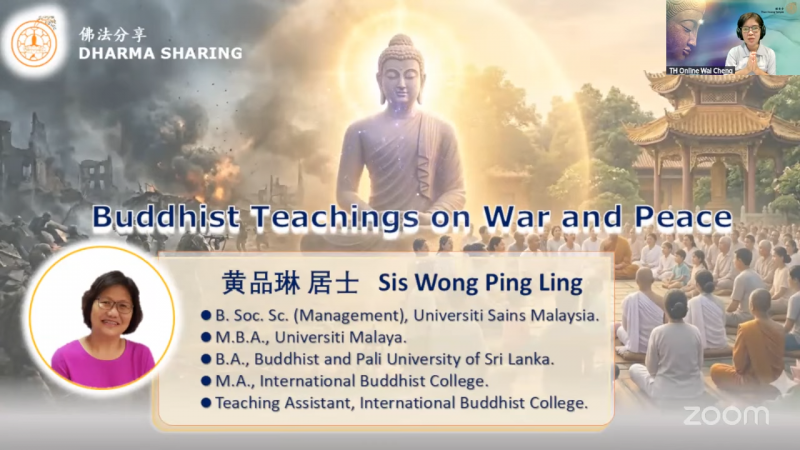
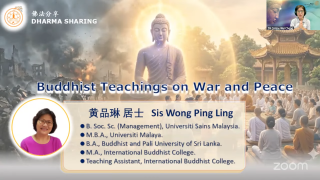
Teaching Assistant of International Buddhist College, Sis Wong Ping Ling shared on " Buddhist Teachings on War and Peace ".
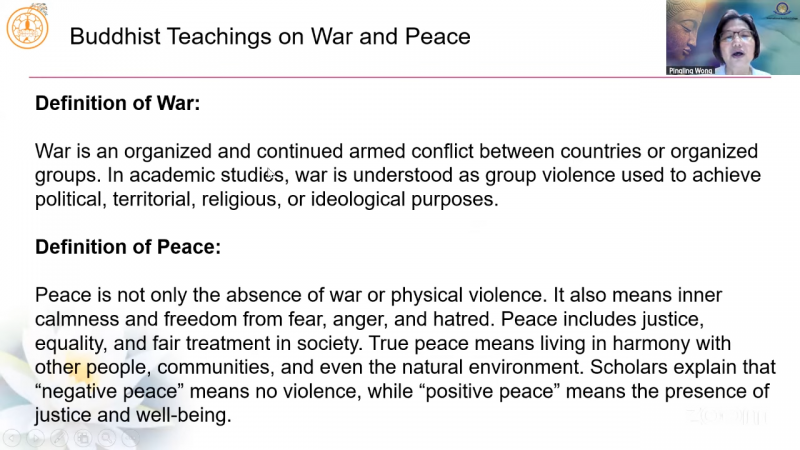
Definition of War:
War is an organized and continued armed conflict between countries or organized groups. In academic studies, war is understood as group violence used to achieve political, territorial, religious, or ideological purposes.
Definition of Peace:
Peace is not only the absence of war or physical violence. It also means inner calmness and freedom from fear, anger, and hatred. Peace includes justice, equality, and fair treatment in society. True peace means living in harmony with other people, communities, and even the natural environment. Scholars explain that “negative peace” means no violence, while “positive peace” means the presence of justice and well-being.
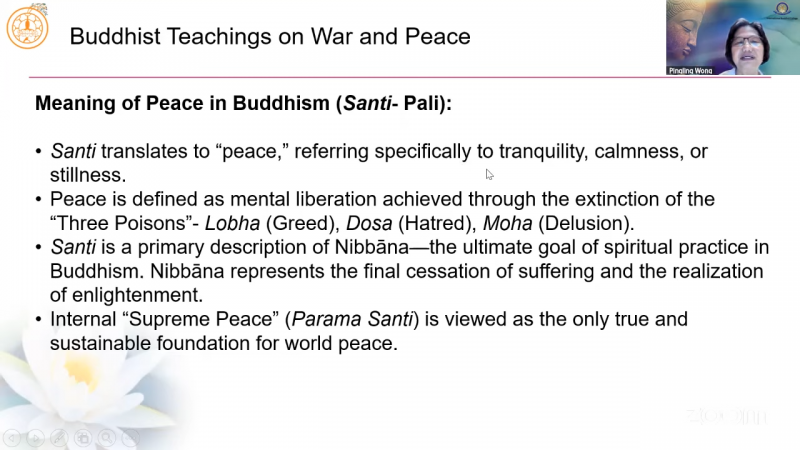
Meaning of Peace in Buddhism (Santi- Pali):
• Santi translates to “peace,” referring specifically to tranquility, calmness, or stillness.
• Peace is defined as mental liberation achieved through the extinction of the “Three Poisons”- Lobha (Greed), Dosa (Hatred), Moha (Delusion).
• Santi is a primary description of Nibbāna—the ultimate goal of spiritual practice in Buddhism. Nibbāna represents the final cessation of suffering and the realization of enlightenment.
• Internal “Supreme Peace” (Parama Santi) is viewed as the only true and sustainable foundation for world peace.
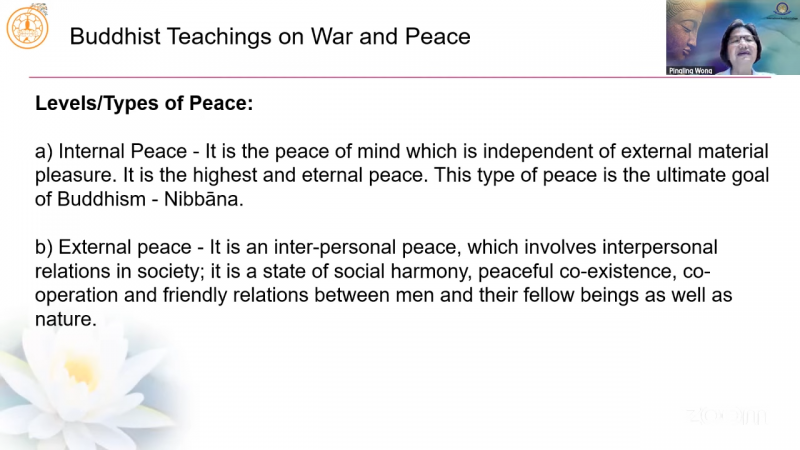
Levels/Types of Peace:
a) Internal Peace - It is the peace of mind which is independent of external material pleasure. It is the highest and eternal peace. This type of peace is the ultimate goal of Buddhism - Nibbāna.
b) External peace - It is an inter-personal peace, which involves interpersonal relations in society; it is a state of social harmony, peaceful co-existence, co- operation and friendly relations between men and their fellow beings as well as nature.
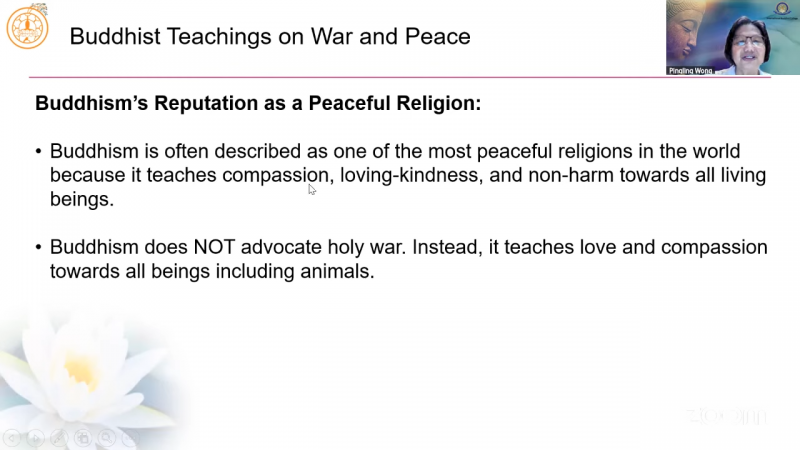
Buddhism’s Reputation as a Peaceful Religion:
• Buddhism is often described as one of the most peaceful religions in the world because it teaches compassion, loving-kindness, and non-harm towards all living beings.
• Buddhism does NOT advocate holy war. Instead, it teaches love and compassion towards all beings including animals.
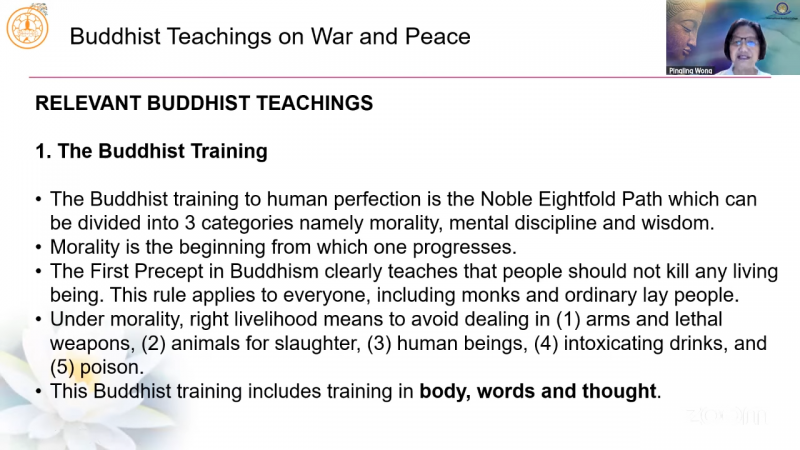
RELEVANT BUDDHIST TEACHINGS
1. The Buddhist Training
• The Buddhist training to human perfection is the Noble Eightfold Path which can be divided into 3 categories namely morality, mental discipline and wisdom.
• Morality is the beginning from which one progresses.
• The First Precept in Buddhism clearly teaches that people should not kill any living being. This rule applies to everyone, including monks and ordinary lay people.
• Under morality, right livelihood means to avoid dealing in (1) arms and lethal weapons, (2) animals for slaughter, (3) human beings, (4) intoxicating drinks, and (5) poison.
• This Buddhist training includes training in body, words and thought.
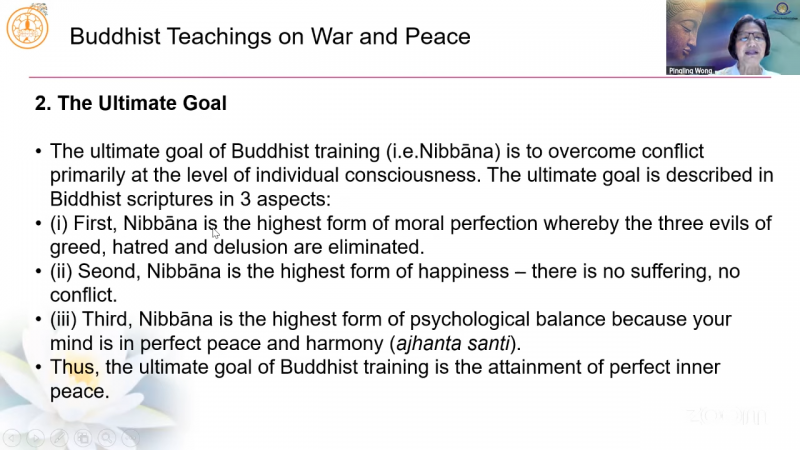
2. The Ultimate Goal
• The ultimate goal of Buddhist training (i.e.Nibbāna) is to overcome conflict primarily at the level of individual consciousness. The ultimate goal is described in Biddhist scriptures in 3 aspects:
• (i) First, Nibbāna is the highest form of moral perfection whereby the three evils of
greed, hatred and delusion are eliminated.
• (ii) Seond, Nibbāna is the highest form of happiness – there is no suffering, no conflict.
• (iii) Third, Nibbāna is the highest form of psychological balance because your mind is in perfect peace and harmony (ajhanta santi).
• Thus, the ultimate goal of Buddhist training is the attainment of perfect inner peace.
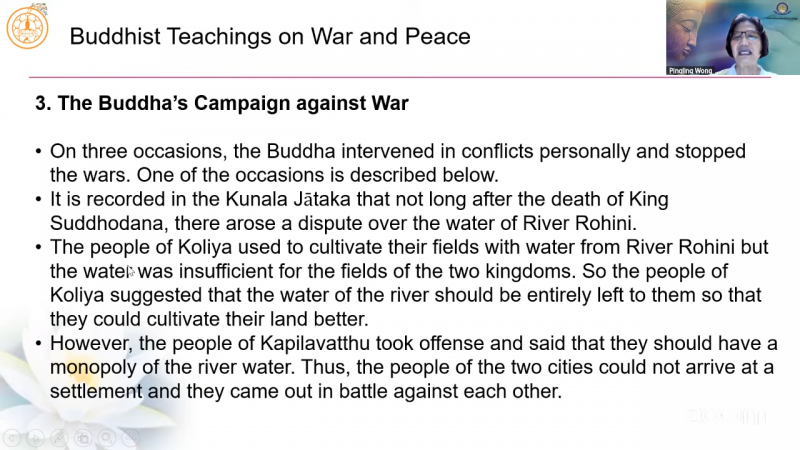
3. The Buddha’s Campaign against War
• On three occasions, the Buddha intervened in conflicts personally and stopped the wars. One of the occasions is described below.
• It is recorded in the Kunala Jātaka that not long after the death of King Suddhodana, there arose a dispute over the water of River Rohini.
• The people of Koliya used to cultivate their fields with water from River Rohini but the water was insufficient for the fields of the two kingdoms. So the people of Koliya suggested that the water of the river should be entirely left to them so that they could cultivate their land better.
• However, the people of Kapilavatthu took offense and said that they should have a monopoly of the river water. Thus, the people of the two cities could not arrive at a settlement and they came out in battle against each other.
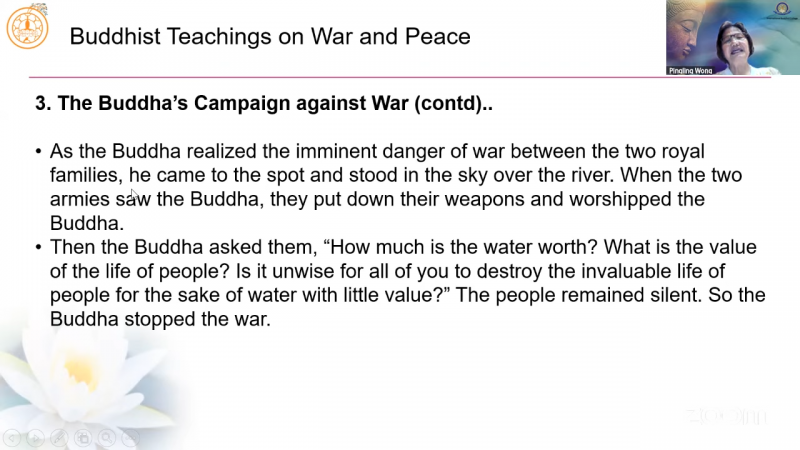
• As the Buddha realized the imminent danger of war between the two royal families, he came to the spot and stood in the sky over the river. When the two armies saw the Buddha, they put down their weapons and worshipped the Buddha.
• Then the Buddha asked them, “How much is the water worth? What is the value of the life of people? Is it unwise for all of you to destroy the invaluable life of people for the sake of water with little value?” The people remained silent. So the Buddha stopped the war.
4. The Buddha’s Comments on War
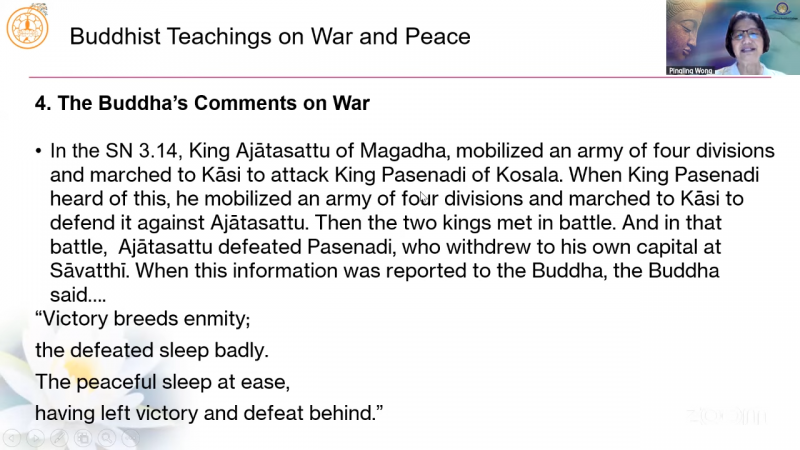
• In the SN 3.14, King Ajātasattu of Magadha, mobilized an army of four divisions and marched to Kāsi to attack King Pasenadi of Kosala. When King Pasenadi heard of this, he mobilized an army of four divisions and marched to Kāsi to defend it against Ajātasattu. Then the two kings met in battle. And in that battle, Ajātasattu defeated Pasenadi, who withdrew to his own capital at Sāvatthī. When this information was reported to the Buddha, the Buddha said….
“Victory breeds enmity;
the defeated sleep badly. The peaceful sleep at ease,
having left victory and defeat behind.”
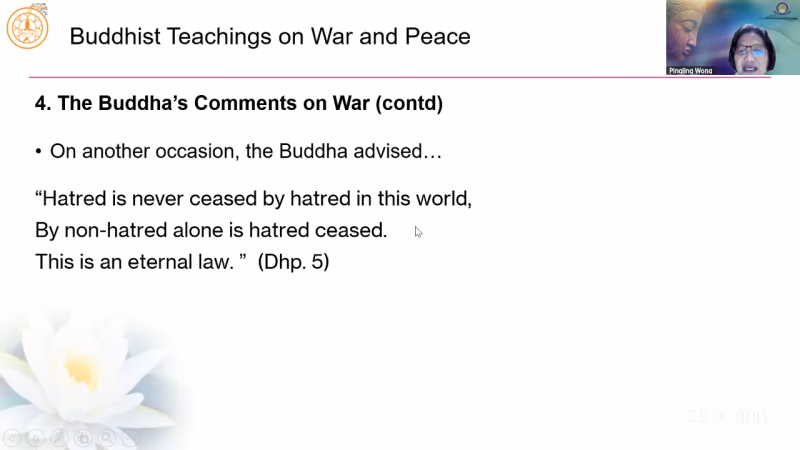
• On another occasion, the Buddha advised…
“Hatred is never ceased by hatred in this world,
By non-hatred alone is hatred ceased.
This is an eternal law. ” (Dhp. 5)
5. The Buddhist Solution to Dispute
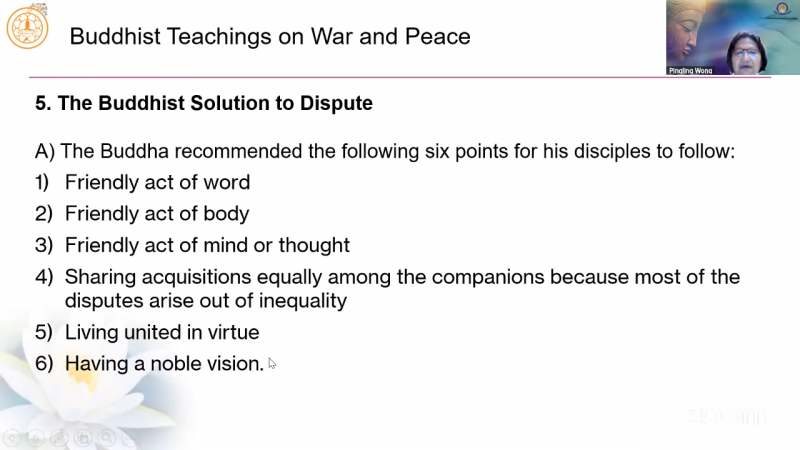
A) The Buddha recommended the following six points for his disciples to follow:
1) Friendly act of word
2) Friendly act of body
3) Friendly act of mind or thought
4) Sharing acquisitions equally among the companions because most of the dispute arises out of inequality
5) Living united in virtue
6) Having a noble vision.
B) Forgiveness
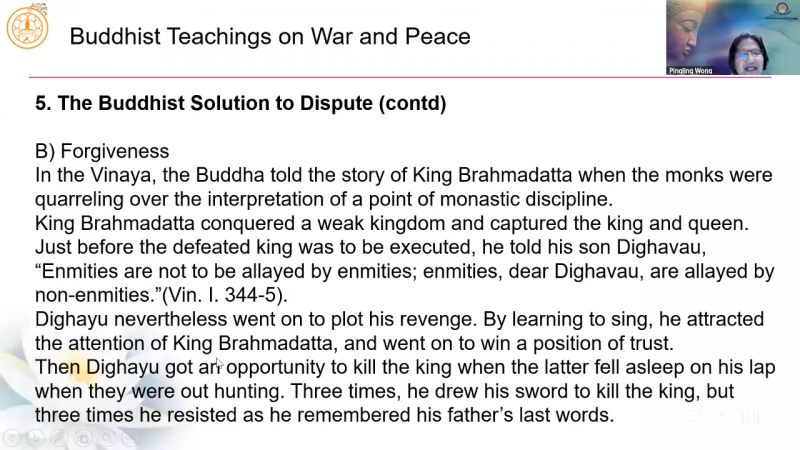
In the Vinaya, the Buddha told the story of King Brahmadatta when the monks were quarreling over the interpretation of a point of monastic discipline.
King Brahmadatta conquered a weak kingdom and captured the king and queen. Just before the defeated king was to be executed, he told his son Dighavau, “Enmities are not to be allayed by enmities; enmities, dear Dighavau, are allayed by non-enmities.”(Vin. I. 344-5).
Dighayu nevertheless went on to plot his revenge. By learning to sing, he attracted the attention of Kin Brahmadatta, and went on to win a position of trust.
Then Dighayu got an opportunity to kill the king when the latter fell asleep on his lap when they were out hunting. Three times, he drew his sword to kill the king, but
three times he resisted as he remembered his father’s last words.
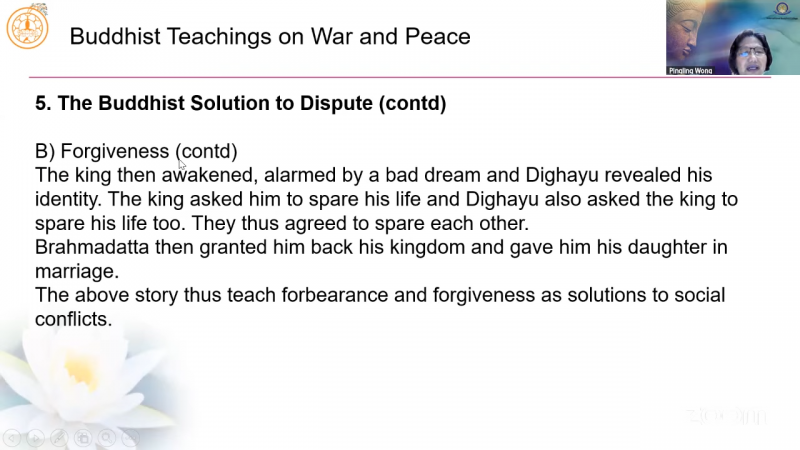
The king then awakened, alarmed by a bad dream and Dighayu revealed his identity. The king asked him to spare his life and Dighayu also asked the king to spare his life too. They thus agreed to spare each other.
Brahmadatta then granted him back his kingdom and gave him his daughter in marriage.
The above story thus teach forbearance and forgiveness as solutions to social conflicts.
6. Ultimate Buddhist Solution
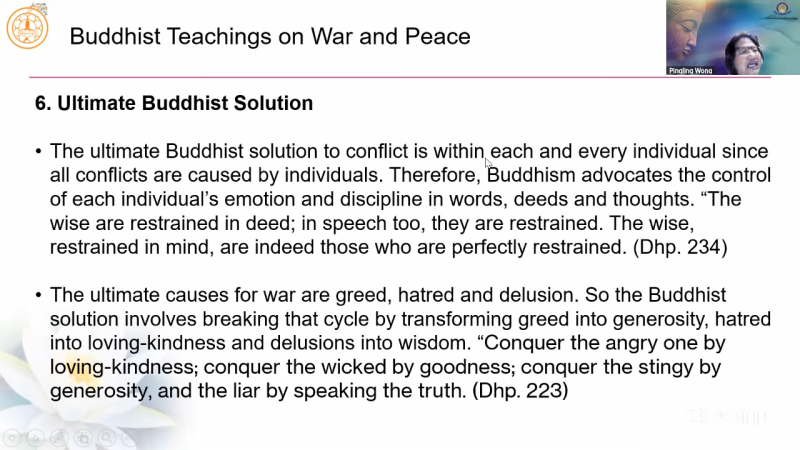
• The ultimate Buddhist solution to conflict is within each and every individual since all conflicts are caused by individuals. Therefore, Buddhism advocates the control of each individual’s emotion and discipline in words, deeds and thoughts. “The wise are restrained in deed; in speech too, they are restrained. The wise, restrained in mind, are indeed those who are perfectly restrained. (Dhp. 234)
• The ultimate causes for war are greed, hatred and delusion. So the Buddhist solution involves breaking that cycle by transforming greed into generosity, hatred into loving-kindness and delusions into wisdom. “Conquer the angry one by loving-kindness; conquer the wicked by goodness; conquer the stingy by generosity, and the liar by speaking the truth. (Dhp. 223)
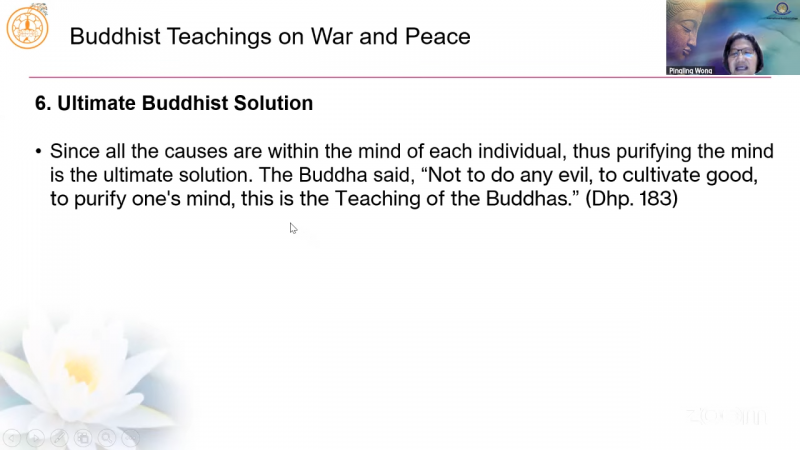
• Since all the causes are within the mind of each individual, thus purifying the mind is the ultimate solution. The Buddha said, “Not to do any evil, to cultivate good, to purify one's mind, this is the Teaching of the Buddhas.” (Dhp. 183)
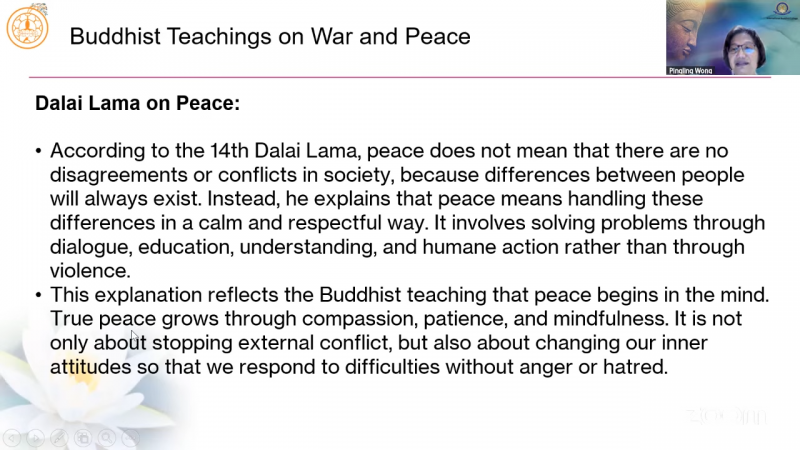
Dalai Lama on Peace:
• According to the 14th Dalai Lama, peace does not mean that there are no disagreements or conflicts in society, because differences between people will always exist. Instead, he explains that peace means handling these differences in a calm and respectful way. It involves solving problems through dialogue, education, understanding, and humane action rather than through violence.
• This explanation reflects the Buddhist teaching that peace begins in the mind. True peace grows through compassion, patience, and mindfulness. It is not only about stopping external conflict, but also about changing our inner attitudes so that we respond to difficulties without anger or hatred.
A Prayer:
May the hostilities/conflicts in the different parts of the world come to an end. May all beings be safe, peaceful and be well and happy!
For more information, please browse https://youtu.be/th4jPaMfwQs
Spread the Buddha's teachings to guide more people to study Buddhism.
Continue diligently in the path studying the Buddha's teachings and listening to the Dharma.
Follow us on:
https://linktr.ee/thanhsiang