Submitted by aier on
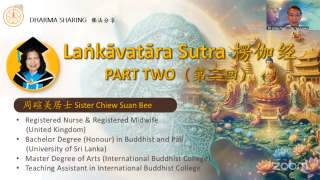
Than Hsiang's Pu Men Pin Online Gong Xiu’s Dharma Sharing(17/07/2026)
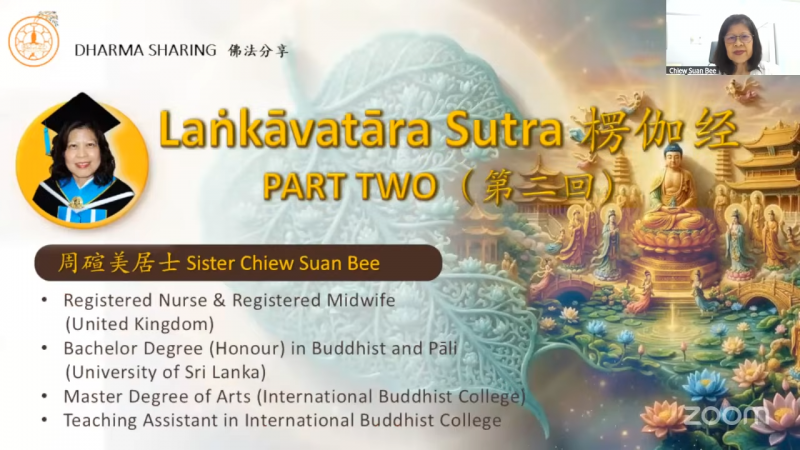
Teaching Assistant in International Buddhist College, Sister Chiew Suan Bee sharing “Laṅkāvatāra sutra ( part 2 )”
LAṄKĀVATĀRA SŪTRA
(Chinese: léng qié jīng 楞伽经)
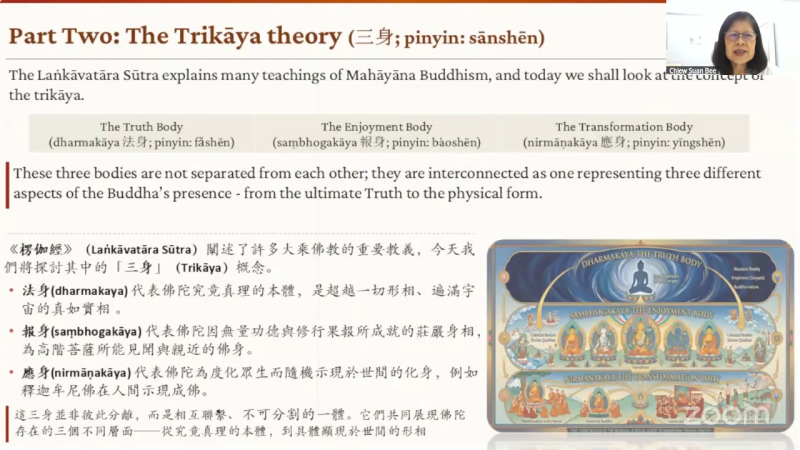
The Laṅkāvatāra Sūtra explains many teachings of Mahāyāna Buddhism, and today we shall look at the concept of the trikāya (三身; pinyin: sānshēn).
1. The Truth Body (dharmakāya 法身; pinyin: fǎshēn)
2. The Enjoyment Body (saṃbhogakāya 报身; pinyin: bàoshēn)
3. The Transformation Body (nirmāṇakāya 应身; pinyin: yīngshēn)
These three bodies are not separated from each other; they are interconnected as one representing three different aspects of the Buddha’s presence - from the ultimate Truth to the physical form.
The Trikāya Theory (三身; pinyin: sānshēn)
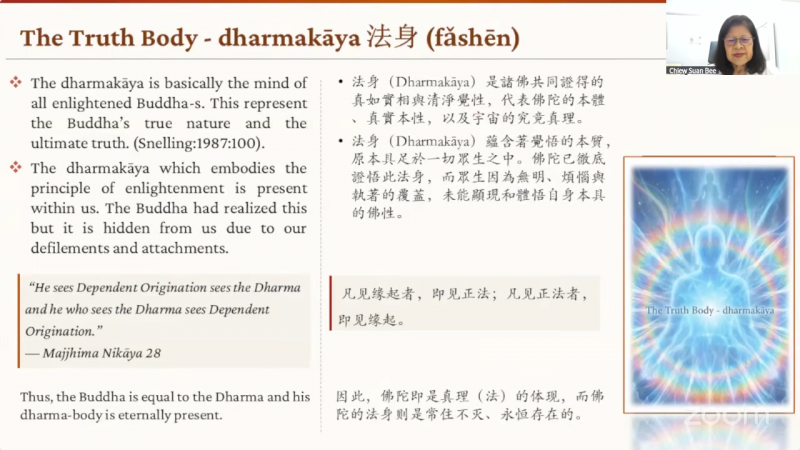
1. The Truth Body (dharmakāya 法身 fǎshēn)
• The dharmakāya is basically the mind of all enlightened Buddha-s. This represent the Buddha’s true nature and the ultimate truth. (Snelling:1987:100).
• The dharmakāya which embodies the principle of enlightenment is present within us. The Buddha had realized this but it is hidden from us due to our defilements and attachments.
“He who sees Dependent Origination sees the Dharma and he who sees the Dharma sees Dependent Origination.” - Majjhima Nikāya 28.
Thus the Buddha is equal to the Dharma and his dharma-body is eternally present.
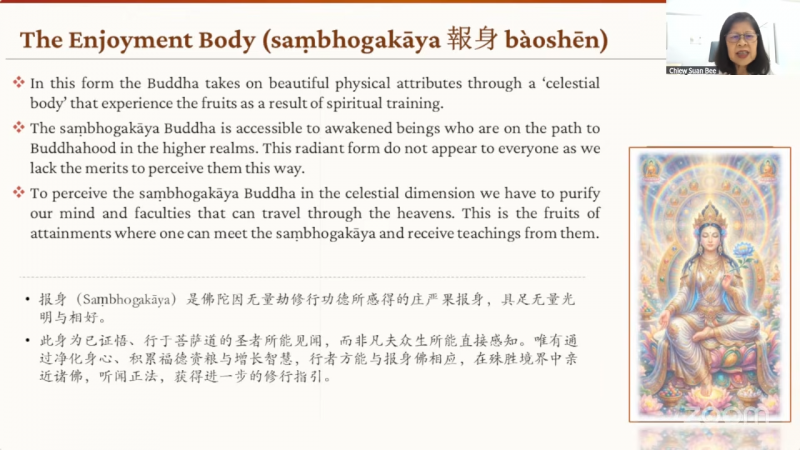
2. Enjoyment Body (saṃbhogakāya 报身 bàoshēn)
• In this form the Buddha takes on beautiful physical attributes through a ‘celestial body’ that experience the fruits as a result of spiritual training.
• The saṃbhogakāya Buddha is accessible to awakened beings who are on the path to Buddhahood in the higher realms. This radiant form do not appear to everyone as we lack the merits to perceive them this way.
• To perceive the saṃbhogakāya Buddha in the celestial dimension we have to purified our mind and faculties that can travel through the heavens. This is the fruits of attainments where one can meet the saṃbhogakāya and receive teachings from them.
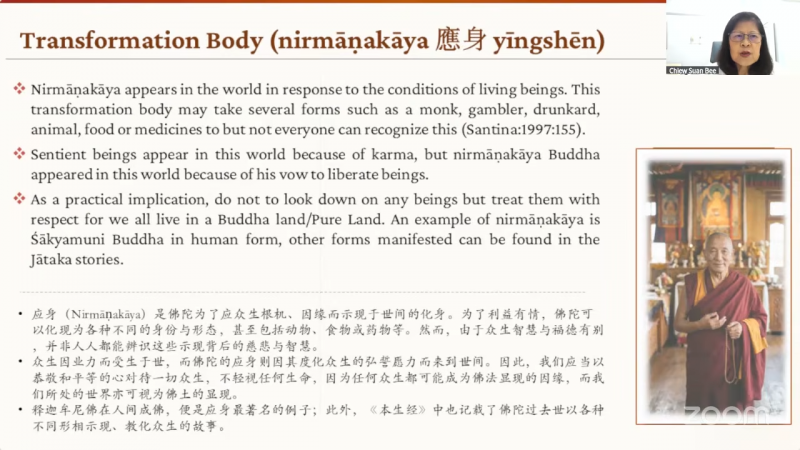
3. Transformation body (nirmāṇakāya 应身 yīngshēn)
• Nirmāṇakāya appears in the world in response to the conditions of living beings. This transformation body may take several forms such as a monk, gambler, drunkard, animal, food or medicines to but not everyone can recognize this (Santina:1997:155).
• Sentient beings appear in this world because of karma, but nirmāṇakāya Buddha appeared in this world because of his vow to liberate beings.
• As a practical implication, do not to look down on any beings but treat them with respect for we all live in a Buddha land/Pure Land. An example of nirmāṇakāya is Śākyamuni Buddha in human form, other forms manifested can be found in the Jātaka stories.
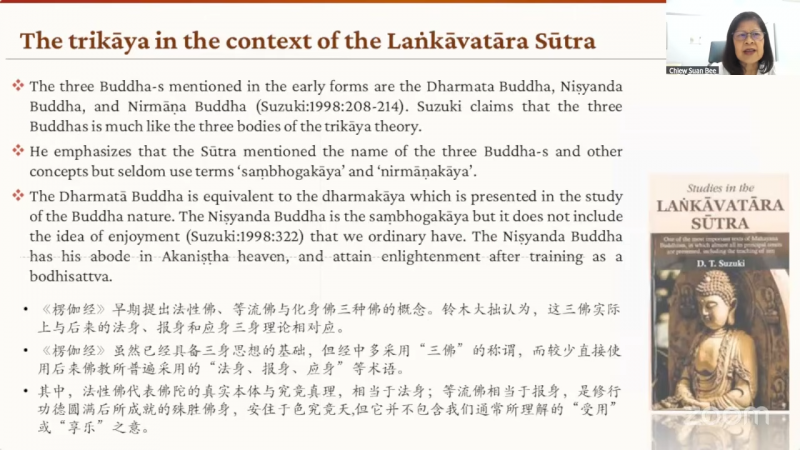
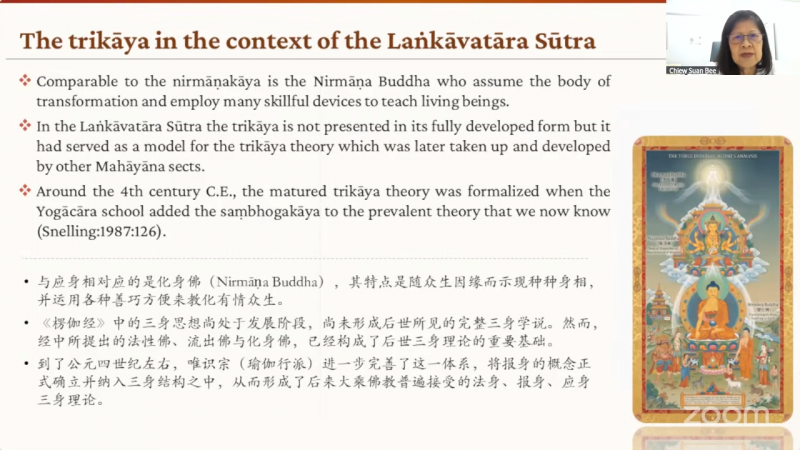
The trikāya in the context of the Laṅkāvatāra Sūtra
• The three Buddha-s mentioned in the early forms are the Dharmata Buddha, Niṣyanda Buddha, and Nirmāṇa Buddha (Suzuki:1998:208-214). Suzuki claims that the three Buddhas is much like the three bodies of the trikāya theory.
• He emphasizes that the Sūtra mentioned the name of the three Buddha-s and other concepts but seldom use terms ‘saṃbhogakāya’ and ‘nirmāṇakāya’.
• The Dharmatā Buddha is equivalent to the dharmakāya which is presented in the study of the Buddha nature. The Niṣyanda Buddha is the saṃbhogakāya but it does not include the idea of enjoyment (Suzuki:1998:322) that we ordinary have. The Niṣyanda Buddha has his abode in Akaniṣṭha heaven, and attain enlightenment after training as a bodhisattva.
• Comparable to the nirmāṇakāya is the Nirmāṇa Buddha who assume the body of transformation and employ many skillful devices to teach living beings.
• In the Laṅkāvatāra Sūtra the trikāya is not presented in its fully developed form but it had served as a model for the trikāya theory which was later taken up and developed by other Mahāyāna sects.
• Around the 4th century C.E., the matured trikāya theory was formalized when the Yogācāra school added the saṃbhogakāya to the prevalent theory that we now know (Snelling:1987:126).
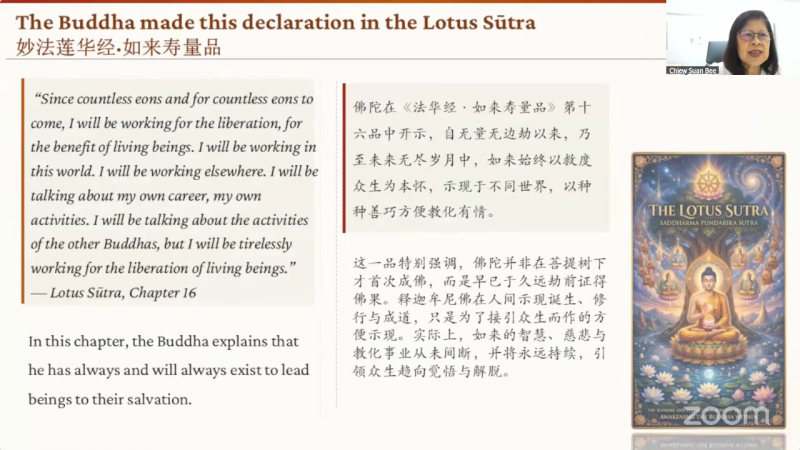
The Buddha made this declaration in the Lotus Sūtra:
“Since countless eons and for countless eons to come, I will be working for the liberation, for the benefit of living beings. I will be working in this world. I will be working elsewhere. I will be talking about my own career, my own activities. I will be talking about the activities of the other Buddhas, but I will be tirelessly working for the liberation of living beings.” - Chapter 16.
In this chapter, the Buddha explains that he has always and will always exist to lead beings to their salvation.
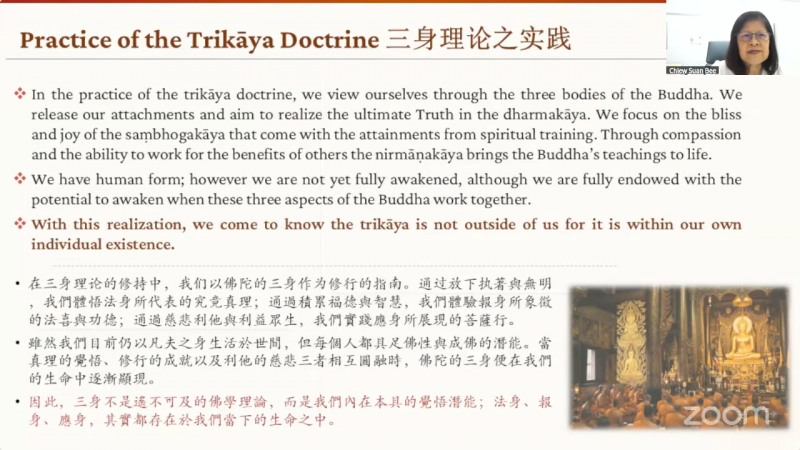
Practice of the Trikāya Doctrine
• In the practice of the trikāya doctrine, we view ourselves through the three bodies of the Buddha. We release our attachments and aim to realize the ultimate Truth in the dharmakāya. We focus on the bliss and joy of the saṃbhogakāya that come with the attainments from spiritual training. Through compassion and the ability to work for the benefits of others the nirmāṇakāya brings the Buddha’s teachings to life.
• We have human form; however we are not yet fully awakened, although we are fully endowed with the potential to awaken when these three aspects of the Buddha work together.
• With this realization, we come to know the trikāya is not outside of us for it is within our own individual existence.
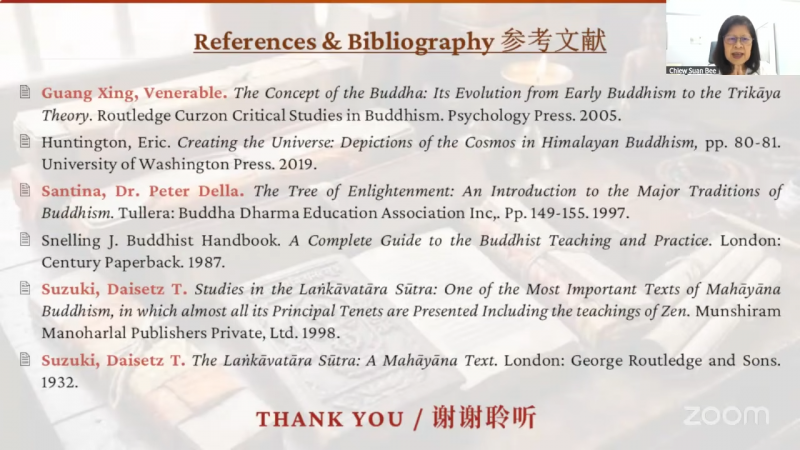
References & Bibliography:
• Guang Xing, Venerable. The Concept of the Buddha: Its Evolution from Early Buddhism to the Trikāya Theory. Routledge Curzon Critical Studies in Buddhism. Psychology Press. 2005.
• Huntington, Eric. Creating the Universe: Depictions of the Cosmos in Himalayan Buddhism, pp. 80-81. University of Washington Press. 2019.
• Santina, Dr. Peter Della. The Tree of Enlightenment: An Introduction to the Major Traditions of Buddhism. Tullera: Buddha Dharma Education Association Inc,. Pp. 149-155. 1997.
• Snelling J. Buddhist Handbook. A Complete Guide to the Buddhist Teaching and Practice. London: Century Paperback. 1987.
• Suzuki, Daisetz T. Studies in the Laṅkāvatāra Sūtra: One of the Most Important Texts of Mahāyāna Buddhism, in which almost all its Principal Tenets are Presented Including the teachings of Zen. Munshiram Manoharlal Publishers Private, Ltd. 1998,
• Suzuki, Daisetz T. The Laṅkāvatāra Sūtra: A Mahāyāna Text. London: George Routledge and Sons. 1932.
For more information, please browse https://www.youtube.com/watch?v=KIVsbTziAV8
Spread the Buddha's teachings to guide more people to study Buddhism.
Continue diligently in the path studying the Buddha's teachings and listening to the Dharma.
Follow us on:
https://linktr.ee/thanhsiang