Submitted by aier on
Than Hsiang's Pu Men Pin Online Gong Xiu’s Dharma Sharing(11/09/2026)
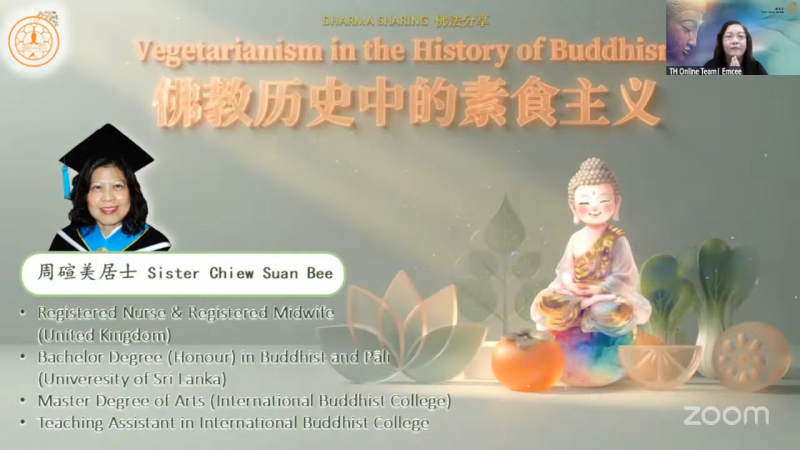
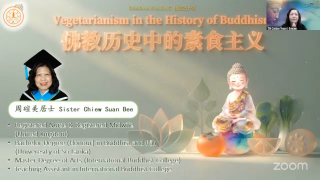
Teaching Assistant in International Buddhist College, Sister Chiew Suan Bee sharing “Vegetarianism in the History of Buddhism ”
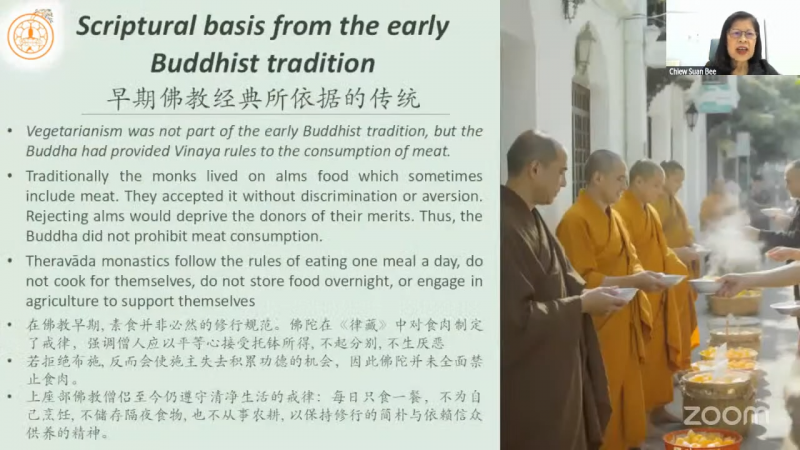
Scriptural basis from the early Buddhist tradition:
• Vegetarianism was not part of the early Buddhist tradition, but the Buddha had provided Vinaya rules to the consumption of meat.
• Traditionally the monks lived on alms food which sometimes include meat. They accepted it without discrimination or aversion. Rejecting alms would deprive the donors of their merits. Thus, the Buddha did not prohibit meat consumption.
• Theravāda monastics follow the rules of eating one meal a day, do not cook for themselves, do not store food overnight, or engage in agriculture to support themselves.
• When Devadatta suggested to make vegetarianism a precept, the Buddha refused as it was incompatible with the monk's lifestyle.
• The Theravadins adhere to the Buddha's rules. They eat meat if the animal was not killed just for them. Mahāyāna tradition embrace vegetarianism with the emphasis rooted in the Bodhisattva's compassion for all sentient beings.
• As Buddhism spread to China, meat consumption became unacceptable due to Confucius's teaching of compassion, imperial decree by Emperor Wudi who banned meat for monks/nuns, so the monastics grew their own food, making vegetarian diet practical.
References taken from the Suttas/Sutras and Vinaya:
• Majjhima Nikaya 55: Jivaka Sutta, "Jivaka, I say there are three instances in which meat should not be eaten: when it is seen, heard or suspected that the living being has been slaughtered for oneself." Meat is considered pure in these 3 aspects, then the monk may eat it (Mahāvagga: 237-238, Cūlavagga: 197). For the part of the donor, he may procure available meat without making himself guilty of intentional killing or instigating others to kill (Mahāvagga: 217).
• Sekhiya Rules 27: alms food is to be received respectfully. If a monk, out of disrespect, receives alms food contemptuously, as if wanting to throw it away, he commits an offense of wrong conduct.
• The Sutta Nipāta 2.2: emphasize that people are defiled, not by eating meat, but by engaging in evil conduct.
Dietary references taken from the Suttas/Sutras and Vinaya:
• Surangama Sutra: Buddhist vegetarianism prohibit food such as leeks, scallions, onions, shallots and garlic collectively known as the five "pungent odours", as these have possible stimulant effects.
• Mahāyāna Mahāparinirvāṇa Sūtra: eating meat will accumulate demerits and destroy the seeds of compassion (Kapleau:1981:34).
• Mahāyāna Angulimālīya Sutra: all sentient beings are equal because they all have the Buddha nature and they will attain Buddhahood in the future.
• Anguttara Nikaya (AN iii 208,5:177): lay Buddhist is to refrain from trading in meat, this being described as 'wrong livelihood'.
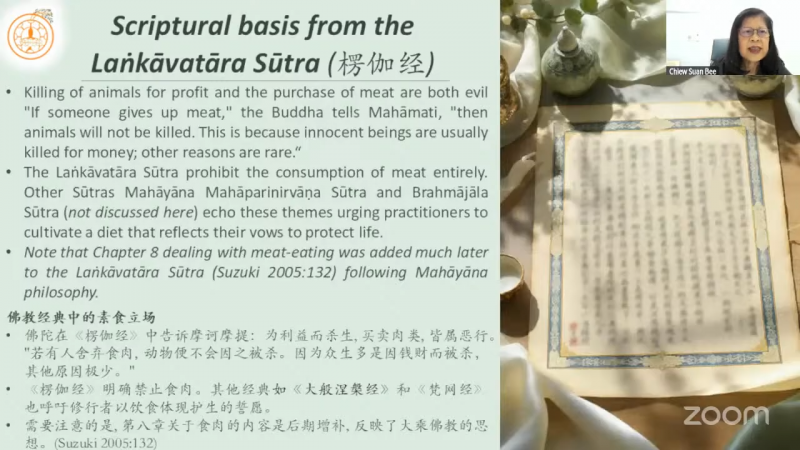
Scriptural basis from the Lankavatāra Sūtra:
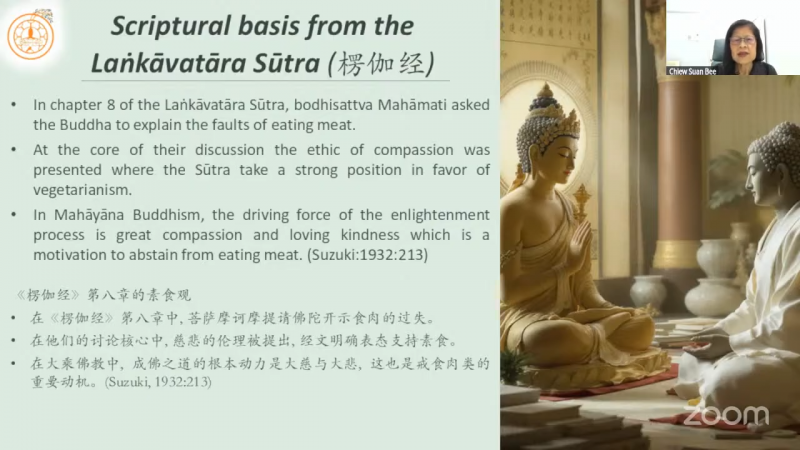
• In chapter 8 of the Lankavatāra Sūtra, bodhisattva Mahāmati asked the Buddha to explain the faults of eating meat.
• At the core of their discussion the ethic of compassion was presented where the Sūtra take a strong position in favor of vegetarianism.
• In Mahāyāna Buddhism, the driving force of the enlightenment process is great compassion and loving kindness which is a motivation to abstain from eating meat. (Suzuki:1932:213)
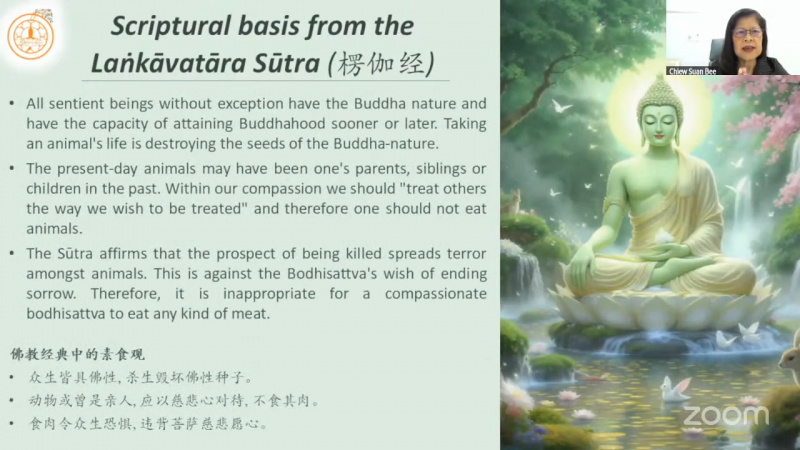
• All sentient beings without exception have the Buddha nature and have the capacity of attaining Buddhahood sooner or later. Taking an animal's life is destroying the seeds of the Buddha-nature.
• The present-day animals may have been one's parents, siblings or children in the past. Within our compassion we should "treat others the way we wish to be treated" and therefore one should not eat animals.
• The Sūtra affirms that the prospect of being killed spreads terror amongst animals. This is against the Bodhisattva's wish of ending sorrow. Therefore, it is inappropriate for a compassionate bodhisattva to eat any kind of meat.
• Killing of animals for profit and the purchase of meat are both evil "If someone gives up meat," the Buddha tells Mahāmati, "then animals will not be killed. This is because innocent beings are usually killed for money; other reasons are rare."
• The Lańkāvatāra Sūtra prohibit the consumption of meat entirely. Other Sūtras Mahāyāna Mahāparinirvāņa Sūtra and Brahmājāla Sūtra (not discussed here) echo these themes urging practitioners to cultivate a diet that reflects their vows to protect life.
• Note that Chapter 8 dealing with meat-eating was added much later to the Lankāvatāra Sūtra (Suzuki 2005:132) following Mahāyāna philosophy.
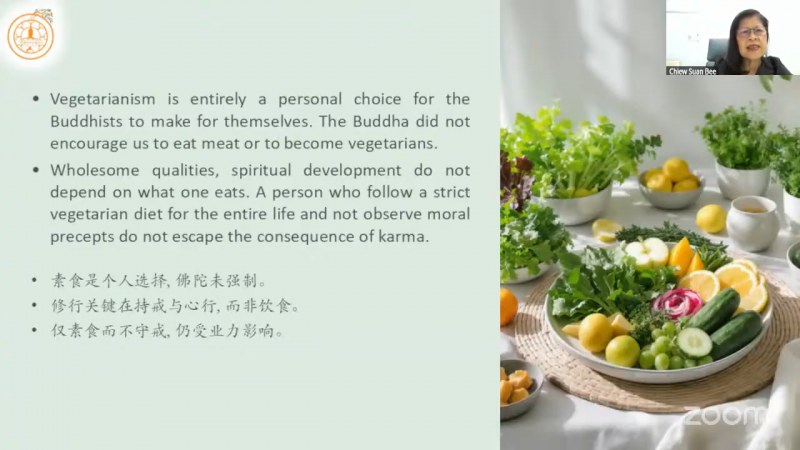
• Vegetarianism is entirely a personal choice for the Buddhists to make for themselves. The Buddha did not encourage us to eat meat or to become vegetarians.
• Wholesome qualities, spiritual development do not depend on what one eats. A person who follow a strict vegetarian diet for the entire life and not observe moral precepts do not escape the consequence of karma.
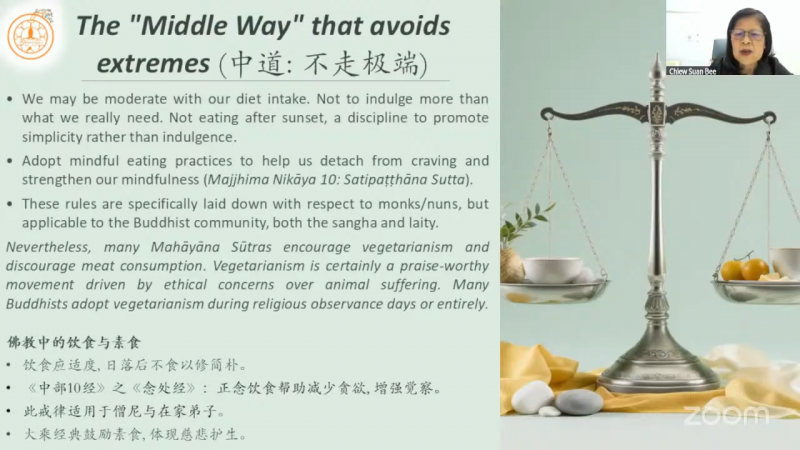
The "Middle Way" that avoids extremes:
• We may be moderate with our diet intake. Not to indulge more than what we really need. Not eating after sunset, a discipline to promote simplicity rather than indulgence.
• Adopt mindful eating practices to help us detach from craving and strengthen our mindfulness (Majjhima Nikaya 10: Satipaṭṭhāna Sutta).
• These rules are specifically laid down with respect to monks/nuns, but applicable to the Buddhist community, both the sangha and laity.
Nevertheless, many Mahāyāna Sutras encourage vegetarianism and discourage meat consumption.
Vegetarianism is certainly a praise-worthy movement driven by ethical concerns over animal suffering.
Many Buddhists adopt vegetarianism during religious observance days or entirely.
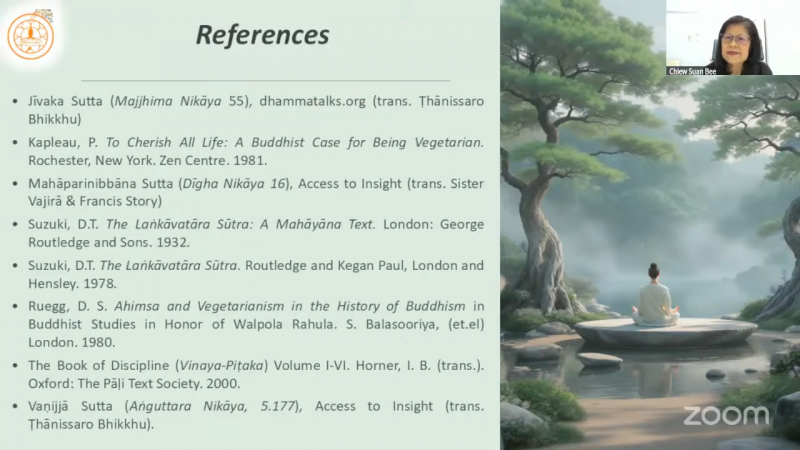
References:
• Jīvaka Sutta (Majjhima Nikaya 55), dhammatalks.org (trans. Thānissaro Bhikkhu)
• Kapleau, P. To Cherish All Life: A Buddhist Case for Being Vegetarian. Rochester, New York. Zen Centre. 1981.
• Mahāparinibbāna Sutta (Digha Nikaya 16), Access to Insight (trans. Sister Vajira & Francis Story)
Suzuki, D.T. The Lankavatāra Sūtra: A Mahāyāna Text. London: George Routledge and Sons. 1932.
• Suzuki, D.T. The Lankāvatāra Sūtra. Routledge and Kegan Paul, London and Hensley. 1978.
• Ruegg, D. S. Ahimsa and Vegetarianism in the History of Buddhism in Buddhist Studies in Honor of Walpola Rahula. S. Balasooriya, (et.el) London. 1980.
• The Book of Discipline (Vinaya-Piṭaka) Volume I-VI. Horner, I. B. (trans.). Oxford: The Pāli Text Society. 2000.
• Vanijjā Sutta (Anguttara Nikaya, 5.177), Access to Insight (trans. Ṭhanissaro Bhikkhu).
For more information, please browse https://www.youtube.com/watch?v=e065FSe68eQ
Spread the Buddha's teachings to guide more people to study Buddhism.
Continue diligently in the path studying the Buddha's teachings and listening to the Dharma.
Follow us on:
https://linktr.ee/thanhsiang