Submitted by aier on
Than Hsiang's Pu Men Pin Online Gong Xiu’s Dharma Sharing(01/08/2025)
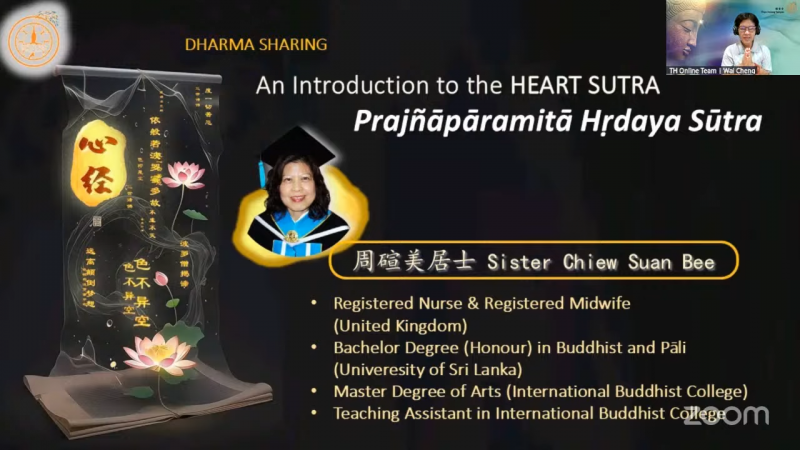
Teaching Assistant in International Buddhist College, Sister Chiew Suan Bee sharing “ An Introduction to the Heart Sutra ”
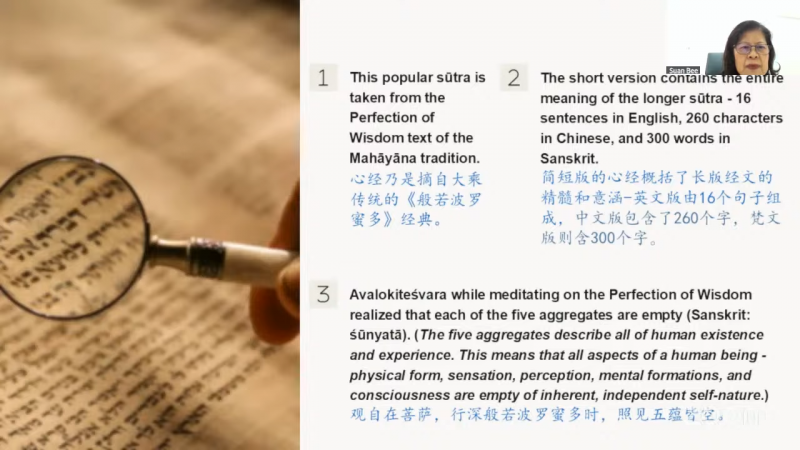
This popular sūtra is taken from the Perfection of Wisdom text of the Mahāyāna tradition.
The short version contains the entire meaning of the longer sūtra - 16 sentences in English, 260 characters in Chinese, and 300 words in Sanskrit.
Avalokiteśvara while meditating on the Perfection of Wisdom realized that each of the five aggregates are empty (Sanskrit: śūnyatā). (The five aggregates describe all of human existence and experience. This means that all aspects of a human being - physical form, sensation, perception, mental formations, and consciousness are empty of inherent, independent self-nature.)
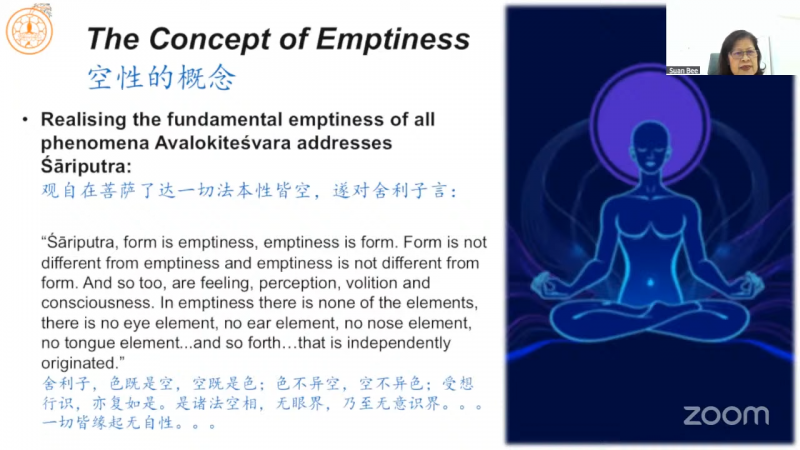
Realising the fundamental emptiness of all phenomena Avalokiteśvara addresses Śāriputra.
“Śāriputra, form is emptiness, emptiness is form. Form is not different from emptiness and emptiness is not different from form. And so too, are feeling, perception, volition and consciousness. In emptiness there is none of the elements, there is no eye element, no ear element, no nose element, no tongue element...and so forth…that is independently originated.”
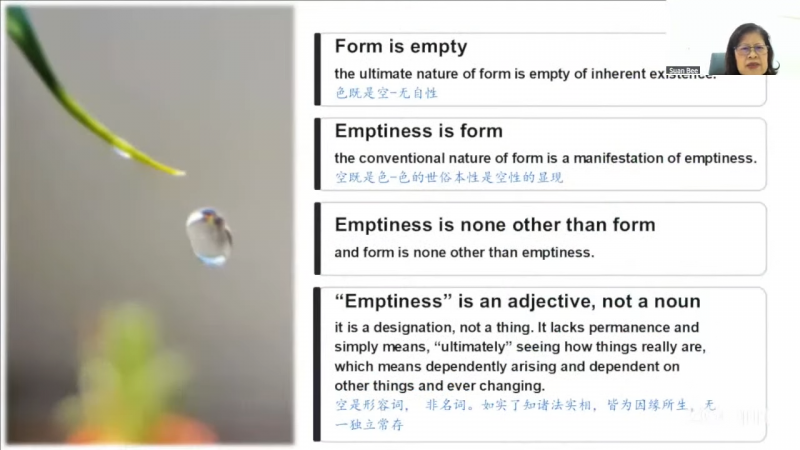
Emptiness is form.
The conventional nature of form is a manifestation of emptiness.
Form is empty.
The ultimate nature of form is empty of Inherent existence.
Emptiness is none other than form, and Form is none other than emptiness.
"Emptiness" is an adjective, not a noun.
It is a designation, not a thing. It lacks permanence and simply means, "ultimately" seeing how things really are, which means dependently arising and dependent on other things and ever changing.
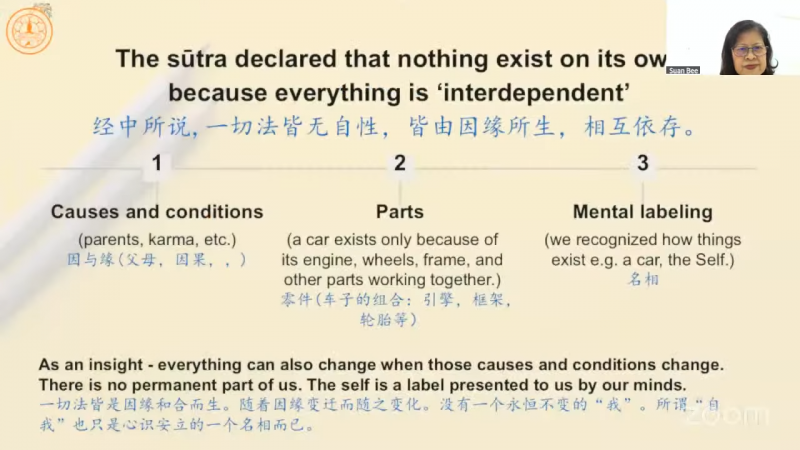
The sūtra declared that nothing exist on its own. Because everything is 'interdependent'
1. Causes and conditions. (parents, karma, etc.)
2. Parts. (a car exists only because of its engine, wheels, frame, and other parts working together.)
3. Mental labeling. (we recognized how things exist e.g. a car, the Self.)
As an insight - everything can also change when those causes and conditions change. There is no permanent part of us. The self is a label presented to us by our minds.
-------------------------------------------------------------------------------------
Today, we are going to look at the Heart Sūtra.
In Sanskrit, the Heart Sūtra is known as the “ Prajñāpāramitā Hṛdaya Sūtra ”, and in Chinese “心经”.
This sūtra belongs to the class of Mahāyāna literature called “Prajñāpāramitā”or the “Perfection of Wisdom”.
Now, let me briefly introduce the background of this important sūtra.
In Sanskrit, the word “Prajñā” means “wisdom” in English;
“Pāramitā” means “Perfection” in English.
The two words together, “Prajñāpāramitā,” means “Perfection of Wisdom.”
The Heart Sūtra that we are going to look at today was inspired and drawn from this important Mahāyāna scripture, the “Prajñāpāramitā” or “Perfection of Wisdom”.
This sūtra has become famous, holy and respected that it is believed today to possess some magical power, for example Xuan Zang(玄奘大师), the Chinese Pilgrim, while he was crossing the deserts of Central Asia, he recited this sūtra, and this sūtra protected him from bandits, wild animals, and desert storms. In those days, in the olden days, around the 6th or 7th century, people tended to travel by foot, and he walked through the deserts of Central Asia, passing through mountain paths and so on, to get to India to look for scripture. So, this sūtra has protected him while he was on this hazardous journey.
The three main characters mentioned in the Heart Sūtra are: Avalokiteśvara, Śāriputra, and the Buddha.
Avalokiteśvara ( the bodhisattva of compassion);
Śāriputra ( one of the disciples of the Buddha, known for his wisdom in understanding sūtra);
and the Buddha was also present, but he was in deep meditation in the background throughout the whole discourses, this was mentioned in the long version of the Heart Sūtra.
So, Buddha was present but in deep meditation.
So, the teaching of the Heart Sūtra was not delivered by the Buddha, but by Avalokiteśvara to Śāriputra.
Today, the Heart sūtra is the most chanted and most widely esteemed text in Mahāyāna tradition.
The entire teaching of this sūtra is very brief, and it is condensed to about one page only.
The teaching in this sūtra reviews about the universe and life as well. This may be one reason why it is so useful to us and why it is so popular.
This popular sūtra is taken from the Perfection of Wisdom text of the Mahāyāna tradition. And, the shortened sūtra contains two version. The one presented today is the short version.
In this short version, you won't see the question asked by Śāriputra, only the answer from Avalokiteśvara.
The short version contains the entire meaning of the longer sūtra, so you do not need to read the whole sūtra because Xuan Zang(玄奘大师)has condensed all the meanings of the longest sūtra into this one page sutra ( the sūtra that you are reciting every day ). And this sutra contains 16 sentences in English, 260 characters in Chinese, and 300 words in Sanskrit.
Avalokiteśvara while meditating on the Perfection of Wisdom realized that each of the five aggregates are empty (Sanskrit for Emptiness is śūnyatā).
(The five aggregates describe all of human existence and experience. This means that all aspects of a human being— you and I— we are made up from: - physical form, sensation, perception, mental formations, and consciousness. And all these are empty of inherent, independent self-nature.)
To explain this briefly, the five aggregates, I think you're all quite familiar with, sometimes you call this skandha.
These five aggregates explain our psycho or rather mental physical self. We are made up of mental ( the body ), sensation, perception, mental formations, and consciousness. And all these things constitute a sentient being. This is the way we construct ourselves.
So, in the Heart Sūtra, when Avalokiteśvara was meditating on the Perfection of Wisdom, He realized that the five aggregates were empty, and this made him realized that there is no self.
And when there is no self, there is nothing to attach to. And when there is no attachment, there is no fear, no worry. So, he is able to keep away from all the distortions in life like desire, ego, suffering, and then get released from the effect of Karma and Saṃsāra. So this means that, the Bodhisattva has no attachment, no hindrances in the mind. So this is the practice we can all do that as well.
Now, we come to the concept of Emptiness.
Realising the fundamental emptiness of all phenomena, Avalokiteśvara addresses Śāriputra.
The Concept of Emptiness
The formula in The Concept of Emptiness is not easy to understand, and we can do it slowly.
You think for a moment.
“ Form is empty; Emptiness is form”, this is the main message in the Heart Sūtra.
So, how do you think of Emptiness?
What Does Emptiness tell you?
Form exists. Form means Form, everything.
Form, they exist, but the end nature or the ultimate nature of form is empty of inherent existence, I mean the self nature. It means, It exists but it is empty of its own nature.
“Emptiness is Form”, this may be a little bit more problematic.
Emptiness is the nature of the form.
Emptiness is present in every form— you and I— you and I can see that the word exists. The world exists, is not empty, we cannot deny this, because you and I experienced it.
But all these things—yourself, myself, everybody, objects, phenomena— they do not have any permanent state of being. So it changes, it is conditioned, and it will disappear, and it does not exist permanently or ultimately. This is why it is called Emptiness, because it does not have its own being ( the Sanskrit word is svabhāva).
So all this thing depends on something for its existence. This is what it means: Form is Empty, Emptiness is Form.
So, in this passage here, Avalokiteśvara is teaching Śāriputra:-
“Śāriputra, form is emptiness, emptiness is form.
Form is not different from emptiness, and Emptiness is not different from Form.
And so too are feeling, perception, volition, and consciousness.
In emptiness, there is none of the elements— there is no eye element, no ear element, no nose element, no tongue element...and so forth— That is independently originated.
The statement here: no tongue element, no eye element, no nose element, and so on, is point out that they do not exist on their own, but they are dependently originated.
So, Dependent Origination is The Twelve Links formula ( Pratītyasamutpāda ).
The Twelve Links formula which explains how we create our suffering and how we create our own self. This is a very important doctrine in Buddhism.
Form is empty - the ultimate nature of form is empty of inherent existence.
Emptiness is form - the conventional nature of form is a manifestation of emptiness.
Emptiness is none other than Form, and Form is none other than Emptiness.
So, as I've mentioned just now, form is empty of its own self nature, but it exists, we cannot say form do not exist.
And when we say Form, we mean our body, ourselves, and all objects and all phenomena, all the things that happened.
So, although these are declared empty, it does not mean nothing or absence, because you can see it exists, right? Emptiness does not mean it does not exist. So, it is empty of its own self nature, and have/has to depend on other things to exist.
Emptiness is Form:
Emptiness is the nature of the Form, as I said, and it is also the basis to which Form exists.
So this emptiness allows for flexibility.
Emptiness is Form: it is flexible and changes, so we can see all this in the world. For example, take the space in the room. The empty room or the room we are sitting in now, it will be people, Furniture, lights, and so on; it exists.
Let me give you another example: you take a cup. A cup is a Form. The drinking cup is a Form.
And at the same time, the cup is also emptiness.
By emptiness, I don't mean empty of tea, coffee, or drink; you probably have a cup with you, and you look at an empty cup. The emptiness is not the empty of tea or water. So, Emptiness is part of the Form of this cup.
So you can say it exists, it does not exist, it's beyond existent and non-existent. The cup exists because it appeared; you can see it, you can see the cup, you can hold it, and you can use it to put your water in for drinking.
But ultimately, one day, your cup will break, and it can also disappear, because it does not have its own self nature. The cup is made up of glass, clay, or whatever, in other conditions for it to exist. So, it has no self a nature. And all conditioned things will disappear, for example, like this cup.
So, Emptiness is none other than Form, and Form is none other than Emptiness.
So these two are interconnected, they are not fixed, their nature arises dependent on something. If everything has a permanent self or nature, things will exist in a fixed state, everything is fixed. We will not be able to change, things will not be able to change, and nothing will grow. So, they are also not fixed. So, both two: Form and Emptiness, are not separable; they exist together.
The sūtra declare that nothing exists on its own, because everything is “interdependent” on causes and conditions.
These are how things are dependent on cause and condition. From the parents, from the Karma, for example, a person— you and I— is dependent, or anyone is dependent on cause and condition. Our body is dependent on our parents’ sperm and egg, and we are dependent on food, air, etc., and so on.
The person also forms from life processes like the Karma, that will determine the condition of this person: where he is going to be born? rich or poor? and so on.
So, we are all part of cause and condition. I am here because of cause and condition, and when the cause and condition change, I will also change, and I will not be here.
So, we exist because of cause and condition.
The other thing is that the dependent is on Parts. A car exists only because of its engine, wheels, frame, and other parts working together, so we call this a car, it is a metaphor, actually, to explain emptiness. When we tear the car apart, the car is no longer then, no more car. So, the car exists dependent on its parts, does not have its own nature, is not permanent, and is not fixed.
The third reason is Mental labeling ( we recognize how things exist, e.g., a car, the Self.)
You think about how you label someone, for example, a person. A person— this is mental labelling— can be kind or cruel. In reality, no one is permanently cruel or permanently kind. People change based on their emotions, based on their circumstances, and their moods as well. So the same with the car, Emptiness, you to see that, these thing are just Mental labelling. So, these are some of the reason, How things are dependent on causes, conditions, parts, and Mental labeling.
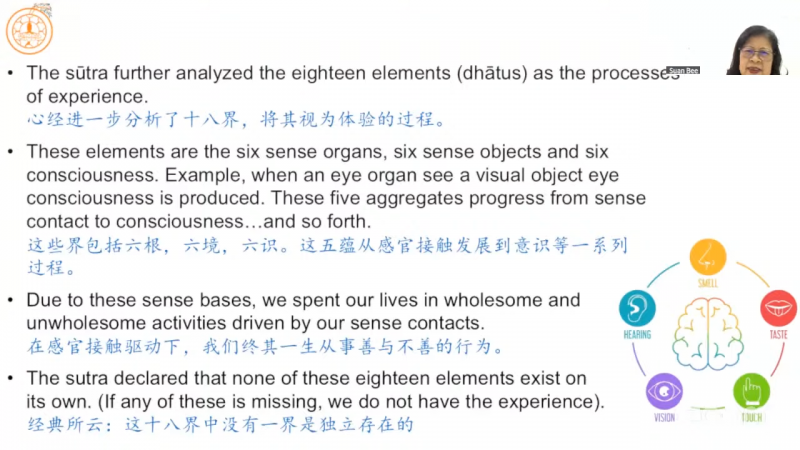
The sūtra further analyzed the eighteen elements ( dhātus ) as the processes of experience, all these are not permanent.
So, in the sūtra, Avalokiteśvara explains that emptiness by breaking up the five aggregates into 18 elements, from 5 to 18. And these 18 elements explain the way all the ways how we are connected to our world.
These elements are the six sense organs, six sense objects, and six consciousness.
And these 18 elements are our six sense organs: eye, ear, nose, tongue, body, and mind;
And these six sense objects: Vision, hearing, smell, taste, touch, and thought.
So, in every case of experience, we have three elements: The sense organ, Sense object, and the sense consciousness. So, for example, when an eye organ sees a visual object, eye consciousness is produced, and this is conceptualized by the mind to form mental awareness.
These five aggregates progress from sense contact to consciousness…and so forth.
So, Due to these sense bases, we spend our lives in wholesome and unwholesome activities driven by our sense contacts.
The sūtra declared that none of these eighteen elements exist on its own. (If any of these is missing, we do not have the experience).
Let me explain further. For example, let's take the first organ only because that's 18; I will not be able to name all of them, so let's take just the eye for example. If our eye is closed, if we close our eyes, we will not be able to see the tree or the girl, and we will not be able to see anything; And if there is no tree or there is no girl, we won’t see even though if the eye is open, the object is not there, and if the mind is distracted, if your mind gets distracted, your mind is not here, you won't be able or you won't be conscious of the tree, because the mind is not present. So, we need to have a combination of all these elements to have a visual consciousness.
The same applies to the other five faculties as well:, the ear, nose, tongue, body, and the mind.
The sūtra declared that 18 elements are empty; do not chase after them, they are empty, and this is Emptiness.
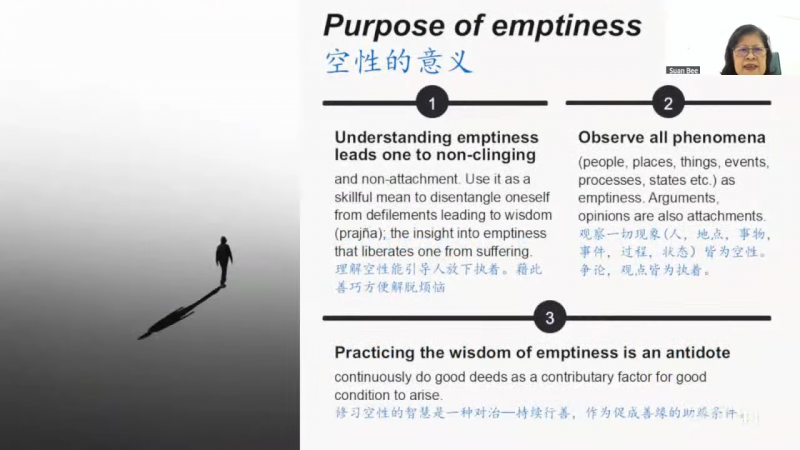
Purpose of Emptiness:
Understanding emptiness leads one to non-clinging and non-attachment.
Use it as a skillful means to disentangle oneself from defilements, leading to wisdom (Prajñā), the insight into emptiness that liberates one from suffering.
So, understanding emptiness, we can let go of our clinging and our grasping, and this is when we don't cling, we can overcome materialism and our ego. This is very important, So, this can be realized by meditation and mindful living.
The second one: observed all phenomena.
Phenomena means places (People, things, events, processes, states etc) as emptiness. Arguments and opinions are also attachments; we have to remember.
When an argument happens, clinging will immediately come in and grab it. And this stays in our mind all the time; it makes us angry, it causes suffering.
So, we can see it as an object which does not serve any purpose. So don't label it. Practice like the principal in your meditation, for example sitting still. Sit still, don't think, not thinking about it, not waiting for anything to happen, do not hold onto it, do not label it. Because they don't have any real existence, and they will fade, they will go away, they will change.
The third one: practising the wisdom of Emptiness is an antidote. Continuously do good deeds as a contributory factor for good conditions to arise. So, practitioners are practice emptiness with empathy. Empathy is the word— empathy for everyone, for others— so see another person shaped by factors of cause and condition. We are born because of cause and conditions, right? So, other people is just the same like ourselves. So, this gives us deeper understanding and this perspective will help us cultivate compassion and patience and let go of all our rigid thinking.
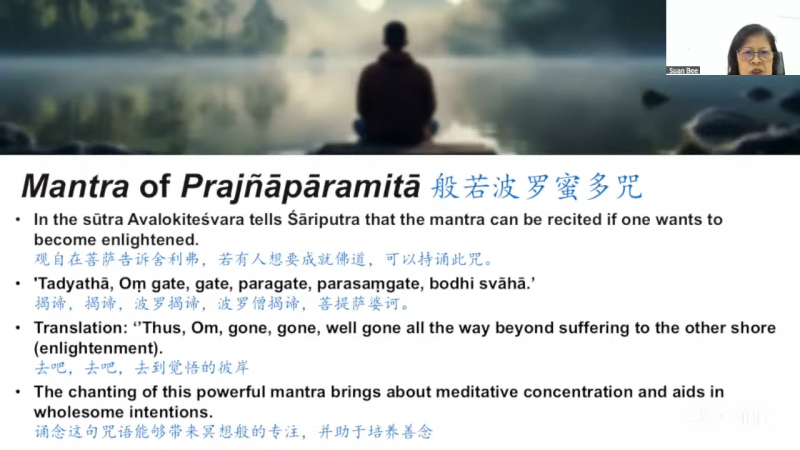
Mantra of Prajñāpāramitā:
In the sutra, Avalokiteśvara tells Śāriputra that the mantra can be recited if one wants to become enlightened.
These are Sanskrit mantra, but you also have it in Chinese.
This is a very famous Mantra found at the end of the Heart Sūtra.
The recitation of the Heart Sūtra or the mantra is a device, is a teaching device, that believed to have an unusual power to effect a change in the person reciting the Mantra or the Sūtra.
It is very auspicious and regarded as a protection like the case of Xuan Zang(玄奘大师)
this is the Mantra in Sanskrit: 'Tadyathā, Oṃ gate, gate, paragate, parasaṃgate, bodhi svāhā.'
Translation: ‘’Thus, Om, gone, gone, well gone all the way beyond suffering to the other shore (enlightenment).
The Heart Sūtra can be used as a Mantra, or you can use it as a Dhāraṇī.
The chanting of this powerful mantra brings about meditative concentration and aids in wholesome intentions.
And the power lies in the sound of the recitation itself. The other ways could be listening to the sūtra, memorizing it or preaching it or copying it or even worshipping it at your altar.
So, actually, Dhāraṇī is a little bit different, you find a lot of Dhāraṇī in the Mahāyāna literature. It is longer than a mantra, and it has the Buddha's teaching in it, so it can be more complex like the Heart Sūtra, even though it is a short version— only 260 characters— it has teaching. So, when you recite it, you remember the teaching.
So, the Heart Sūtra has become part of our daily life, and for most of us, and for millions and millions of Buddhist all around the world.
We have also got to remember that the Heart Sūtra must be recited in mindfulness practice.
When you recite the Heart Sūtra, it has to be meditative concentration.
For more information, please browse https://www.youtube.com/live/3kgyl0bT3m8
Spread the Buddha's teachings to guide more people to study Buddhism.
Continue diligently in the path studying the Buddha's teachings and listening to the Dharma.
Follow us on:
https://linktr.ee/thanhsiang