Submitted by aier on
Than Hsiang's Pu Men Pin Online Gong Xiu Dharma Sharing (20/11/2026)
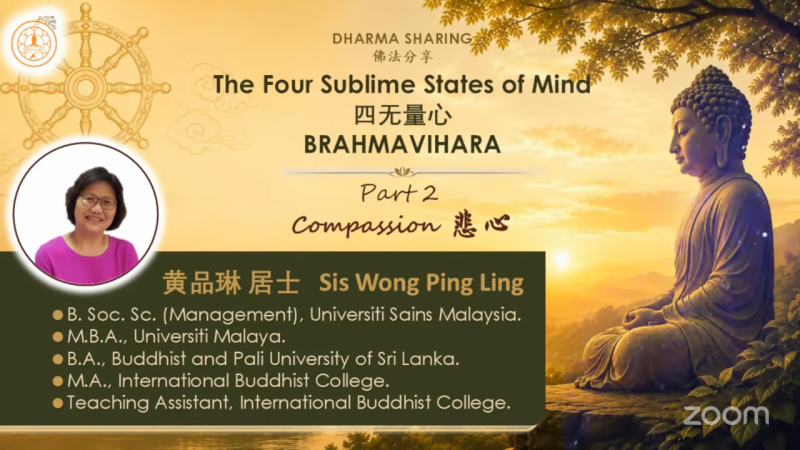
Teaching Assistant of International Buddhist College, Sis Wong Ping Ling shared on " The Four Sublime States of Mind ( Part 2 ) "
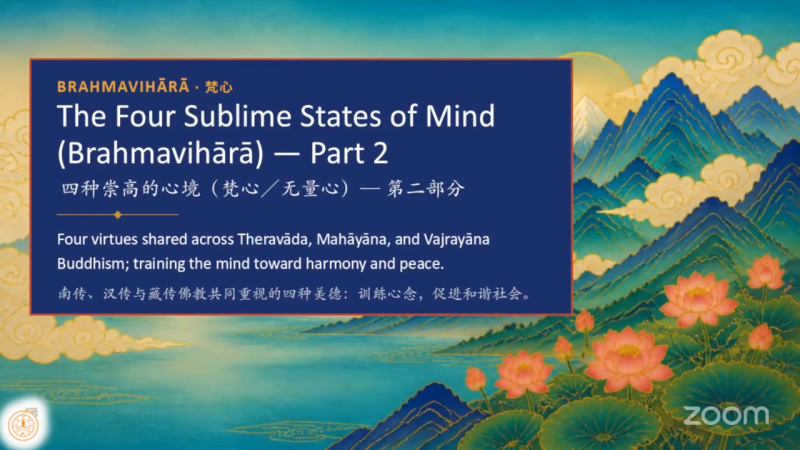
Today, I will continue my sharing on the Four Sublime States of Mind, Part Two.
In this part, I will focus on Compassion, the second of the Four Sublime States of Mind.
In Part One( https://www.thanhsiang.org/en/node/2476), which I shared in September 2026, I shared that the Four Sublime States of Mind are common to the Theravada, Mahayana and Vajrayana traditions.
These Four States of Mind or Four Virtues are said to be sublime because they are the right way of conduct towards living beings.
These Four Sublime States of Mind or the Four Virtues contribute to a harmonious society. As they remove tension, they are the great peacemakers in social conflict and the great healers of wounds.
Today, I will focus on Compassion.
Compassion is known as Karuṇā in both Pali and Sanskrit.
In simple terms, Karuṇā is defined as the wish for all beings to be free from suffering, and it will overcome cruelty.
Now, let us look at Compassion in more detail.
The operative word here is “free”—free from suffering. Compassion is the wish for all beings to be free from suffering. It is more than pity or sympathy. It goes beyond simply feeling sorry for others.
Practising compassion enables us to recognise the suffering experienced by all living beings and inspires us to alleviate it.
It is a deep form of empathy that motivates us to take compassionate action and help others become free from suffering.
The central idea is the wish for all beings to be free from suffering. The word “free” is especially important. It is the key to understanding compassion.
Compassion may also involve taking practical steps to help others overcome their suffering.
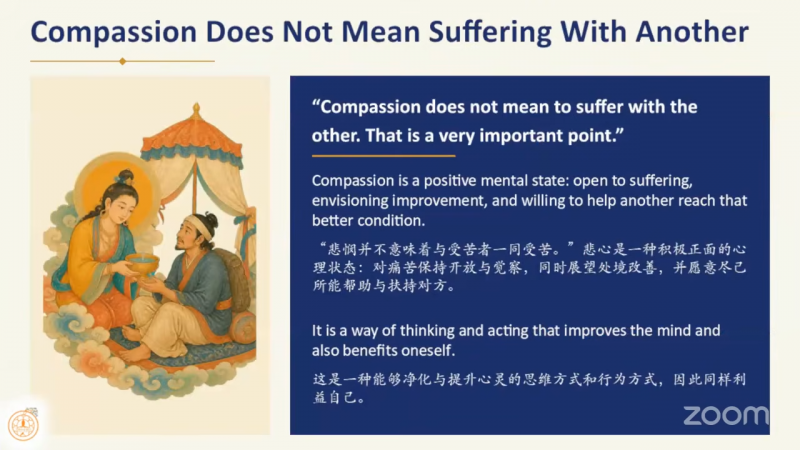
There are many definitions of compassion. A very detailed explanation of compassion is given by Bhikkhu Anālaya, who has written a book called “Compassion and Emptiness in Early Buddhist Meditation." In an interview, he said that compassion does not mean to suffer with the other. That is a very important point. You do not like to suffer with the other. You know that they are suffering, but you do not suffer with the other. Instead of being a painful mental condition in which we suffer with the other, compassion is actually a positive mental state that is open to the suffering but envisions an improvement of the condition of the other and is willing to go out of one's way to help and aid the other person to reach that better condition. The joy of compassion comes from our willingness to prioritize helping others. This attitude and way of acting also benefit our own minds. In essence, compassion is the wish to free others and all sentient beings from suffering. Once again, the key word is "free." It is out of that willingness to give priority to helping the other. That is where the joy comes from. This is a way of thinking and a way of acting that improves the mind, and so it is also good for oneself. So, compassion does not mean you suffer. But the important thing is that it is this wish to free the other or to free all sentient beings from suffering. The operative word is free.
For example, we may have read about the flash floods and mudslides in Nepal in August 2026. Photographs and news reports showed the suffering of those affected by the disaster. Seeing these images, we may feel empathy and be moved to help relieve their suffering. You have read, or you know, of many Buddhist NGOs; many Buddhist groups have sent aid to help these people affected by the Nepal flood. So you contribute; you also contribute to all this aid, and then you envision that your contribution, together with the contribution of so many people around the world, will help to alleviate their suffering. So to alleviate their suffering or to free their suffering, that is a very important point. So it does not mean suffering with the people, but instead it's a positive mental attitude, a positive mental mind that you would help to alleviate or to free their suffering. This is compassion as defined.
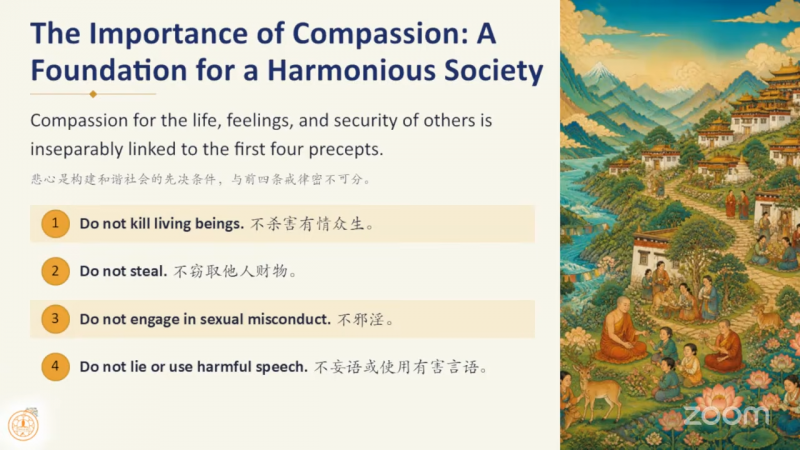
Compassion is essential. It forms the foundation of a harmonious society. When you know we have these first four precepts in Buddhism: do not kill living beings, do not steal, do not engage in sexual misconduct, and do not lie or use harmful speech. These first four precepts, the very important component behind it, are compassion. Why do we say so? Because it is compassion for the life and feelings and security of others. We have compassion for the life, feelings, and security of others. That is why we uphold these four precepts.
You look at the first precept: do not kill living beings. You know that everyone treasures their life. Everyone places importance on their lives. You do not kill living beings because you do not want to bring harm to that person and you do not want their family to suffer. That is very important. It is compassion that leads you to keep this precept: do not kill living beings.
Similarly, the second precept is do not steal. Again, it is compassion. You do not want to harm others; you do not want them to suffer. So, you do not steal.
Thirdly, do not engage in sexual misconduct. For instance, you do not engage in adultery because you do not want to bring suffering to the person's wife or spouse. So, you do not want this; this is a compassion for the feelings of that family member. So, these are all.
Similarly, you do not want to use harmful speech because it's compassion for the feelings of the others.
See, all these activities that avoid harming others are expressions of the wish for others to be free from suffering. Thus, they are expressions of compassion. So, when we hold our precepts, we are actually expressions of compassion because we do not want to harm others. So, we want to alleviate it, or we want to free them from suffering. So, this is a very important point on compassion.
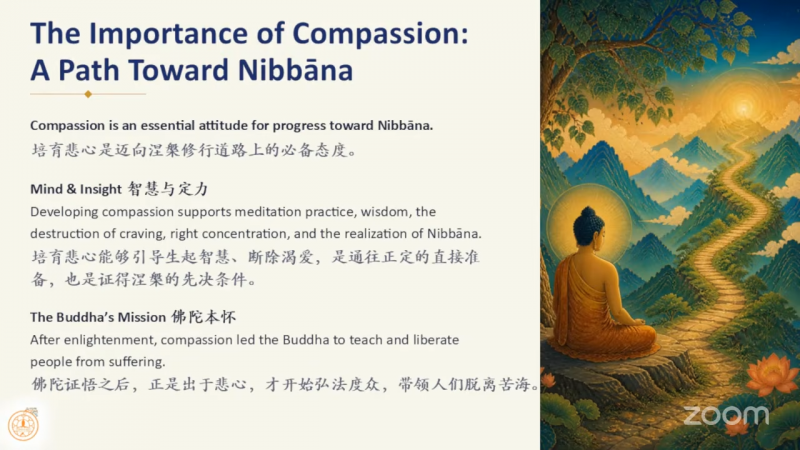
Besides being a prerequisite for a harmonious society, compassion is important because it is an essential attitude for progress along the path towards Nirvana. The development of compassion plays an essential part in the meditation practice that leads towards wisdom and the destruction of craving. The development of a compassionate mind is a direct preparation for right concentration and a prerequisite of Nirvana. If you want to progress towards Nirvana, compassion is a very essential attitude.
Thirdly, compassion is also very important because it was compassion that led the Buddha after enlightenment to teach.
Why was the Buddha encouraged to teach after he attained enlightenment? That is because of compassion. He wants the compassion for human beings because he wants to liberate people from suffering. Remember our first noble truth: life is suffering. So, he teaches us how to get out of suffering. That is the Buddha's teaching. So, it is this compassion that led the Buddha to teach after his enlightenment.
So, we can see that compassion is very important, important for a harmonious society.
It is also important for those who like to progress towards enlightenment or towards Nirvana.
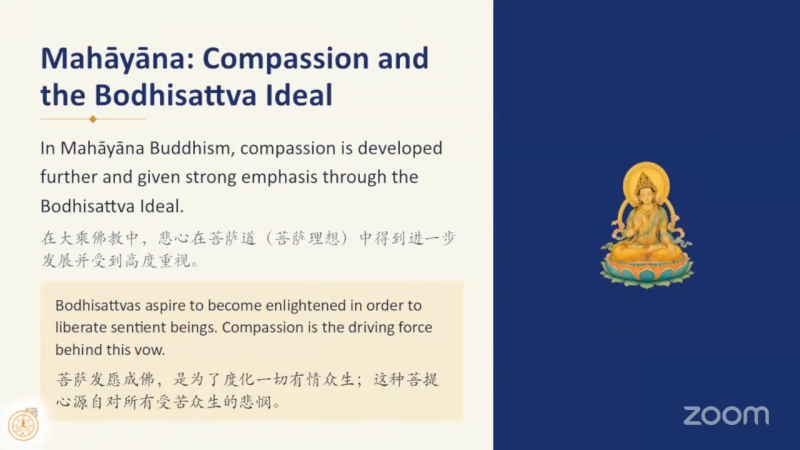
In Mahayana Buddhism, the compassion, the concept of compassion has been developed further and is given much emphasis with the Bodhisattva ideal.
In Mahayana Buddhism, we are encouraged to follow the Bodhisattva path to attain full and complete Buddhahood, instead of the Arahant path. we are encouraged to follow this Bodhisattva path to attain full Buddhahood.
And Bodhisattvas, they aspire to become enlightened in order to liberate sentient beings. And this Bodhisattva inspiration is out of compassion for all suffering beings. And this compassion is again the driving force behind Mahayana. It is the driving force for the Bodhisattva ideal. It is compassion which is the driving force.
When we talk of compassion, for us ordinary beings, we are just talking about ordinary compassion. For the Buddhas and Bodhisattvas, what they have is called great compassion. Actually, this great compassion was developed from a Buddhist school called Sarvāstivāda. And that is why the Buddhas and Bodhisattvas are said to have great compassion.
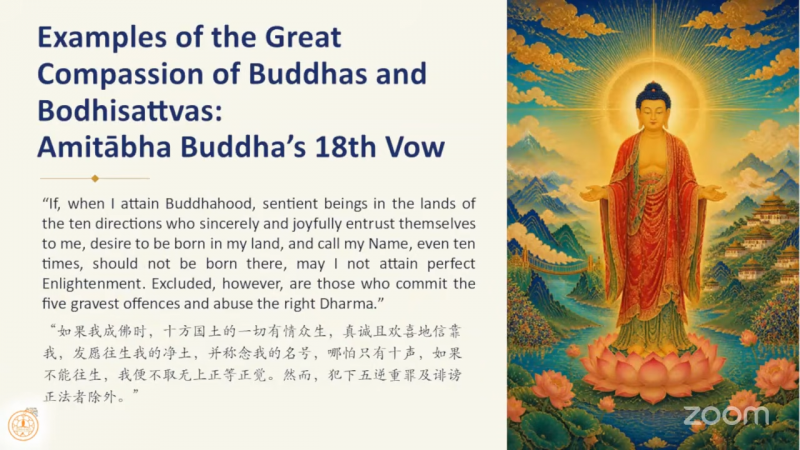
These are examples of the great compassion of the Buddhas and Bodhisattvas. You know about Amitabha Buddha. Amitabha Buddha has made 48 great vows. And the most famous of Amitabha Buddha's vows is his 18th vow. His 18th vow. He said, "If when I attain Buddhahood, sentient beings in the Lands of the Ten Directions, who sincerely and joyfully entrust themselves to me, desire to be born in my land and call my name, even ten times, even just ten times, should not be born there, may I not attain perfect enlightenment. Excluded, however, are those who commit the five greatest offenses and abuse the right dharma.
So if you call upon, you chant, “Namo Amitabha." "Even ten times, you can be reborn in Amitabha's pure land, Amitabha's land of ultimate bliss, which he has created out of compassion for all of us. This is, you know, it's such a great vow he has made. You know, this is the great compassion of the Amitabha Buddha, who has created this pure land out of great compassion for all of us. And we can be reborn in his pure land; even if you just chant his name ten times, you know, Namo Amitabha, sincerely, of course, and you can be reborn in his pure land. Of course, excluded are those who commit the five greatest offenses and abuse the right dharma. This is one example of the great compassion of the Buddhas.
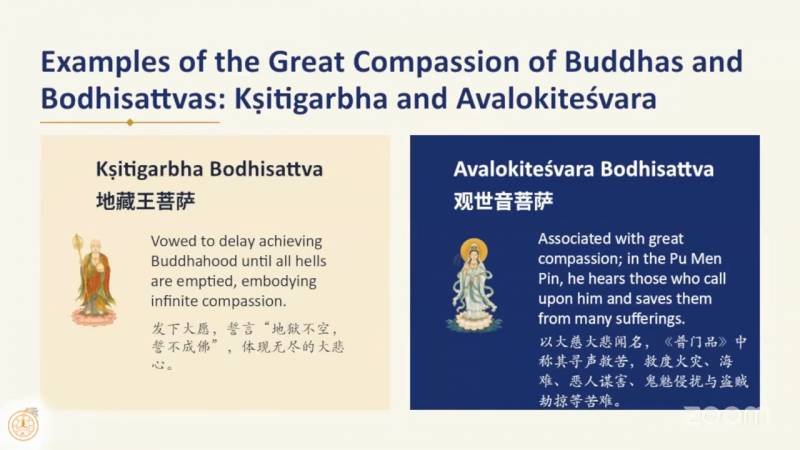
Another example of the great compassion of the Buddhas and Bodhisattvas is Kṣitigarbha Bodhisattva.
Kṣitigarbha Bodhisattva is the Sanskrit name for Dì Zàng Wáng Bodhisattva (地藏王菩薩).
Dìzàng Wáng Bodhisattva is known as the Bodhisattva with great vows. That's why we always chant Namo Dà Yuàn Dì Zàng Wáng Bodhisattva. Why is he known as the Bodhisattva with great vows? Because Kṣitigarbha Bodhisattva and Dì Zàng Wáng Bodhisattva vowed to delay achieving Buddhahood until all hells are emptied. Until all hells are emptied. This is meaning it will continue for infinite time. He won't attain Buddhahood until all hells are emptied. Because of that, he is known as Namo Dà Yuàn (Great Vow), Dìzàng Wáng Bodhisattva. And this embodies infinite compassion. Because when all hell is emptied, only he will attain Buddhahood. So, this is another example of the great compassion of the Buddhas and Bodhisattvas.
And of course another example that I would like to share today is that of Avalokiteśvara Bodhisattva, whose Sanskrit name for Kuan Si Ying Bodhisattva or Avalokiteśvara Bodhisattva is also associated with great compassion. As stated in the Pu Men Ping, chapter 25 of the Lotus Sutra. Chapter 25 in Chinese is the Miàofǎ Liánhuā Jīng–Guānshìyīn Púsà Pǔmén Pǐn; it's a chapter 25 of the Lotus Sutra. And in that it is said that Avalokiteśvara Bodhisattva, or Kuan Si Ying Bodhisattva, will heed those who call upon him and save them from various sufferings. For instance, fire, floods, storms on the ocean, murderers, demons and ghosts, robbers, etc.
So again, this is another example of great compassion. That is why when we chant Kuan Si Ying Bodhisattva, sometimes you have to chant Namo Dàcí Dàbēi Guānshìyīn Bodhisattva. The “Dàcí” is a great method, great loving kindness, which is the first of the four sublime states of mind, which I already dealt previously in September.
And the other one is Namo Dàcí Dàbēi. Dàbēi is great compassion. So that's why when we chant, we sometimes chant as Namo Dàcí Dàbēi Guānshìyīn Bodhisattva.
So this is another example of the great compassion of the Buddhas and Bodhisattvas.
Now, with this great compassion, we only use it again. Emphasize that we only use it for the Buddhas and Bodhisattvas. For us human beings, it is just ordinary compassion.
So for us, as ordinary human beings, we are encouraged to develop or cultivate our ordinary compassion. We are encouraged to cultivate our ordinary compassion by our everyday conduct and by meditation so that we can contribute to a harmonious society. Because today we are dealing with the four sublime states of mind.
And as I state right from the beginning, these four sublime states of mind are very important for a harmonious society. So on our part, we cultivate this compassion, our ordinary compassion, so that we can contribute to a more harmonious society.
With that, I conclude my sharing for today. Thank you for listening. Amitabha.
---------------------------------------------------------------------------------------------------------------------------
These are four sublime states of mind common to the Theravāda, Mahāyāna and Vajrayāna traditions.
These four virtues are said to be sublime or excellent because they are the right way of conduct towards living beings.
They contribute to a harmonious society as “they are the great removers of tension, the great peace-makers in social conflict, and the great healers of wounds suffered in the struggle of existence.” (Nyanaponika Thera, 1994)
All social problems can be traced to the human mind and the solution is to train our minds with these four qualities.
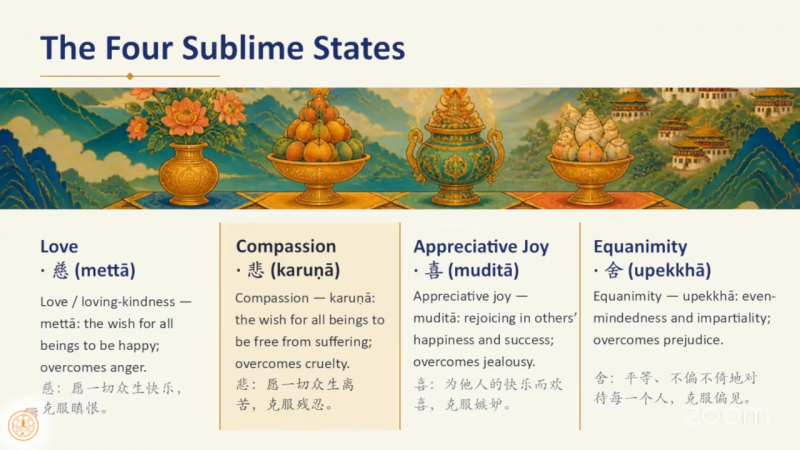
1. Love or loving-kindness (mettā):
- the wish for all beings to be happy.
- Loving-kindness seeks to overcome anger.
2. Compassion (karuṇā):
- the wish for all beings to be free from suffering.
- Compassion seeks to overcome cruelty.
3. Appreciative/Sympathetic Joy (muditā):
- Sympathetic joy arises when one rejoices over the happiness of others and wishes others well-being and success.
- This seeks to overcome jealousy.
4. Equanimity (upekkhā) :
- Even-mindedness, treating everyone impartially.
- Equanimity seeks to overcome prejudice.
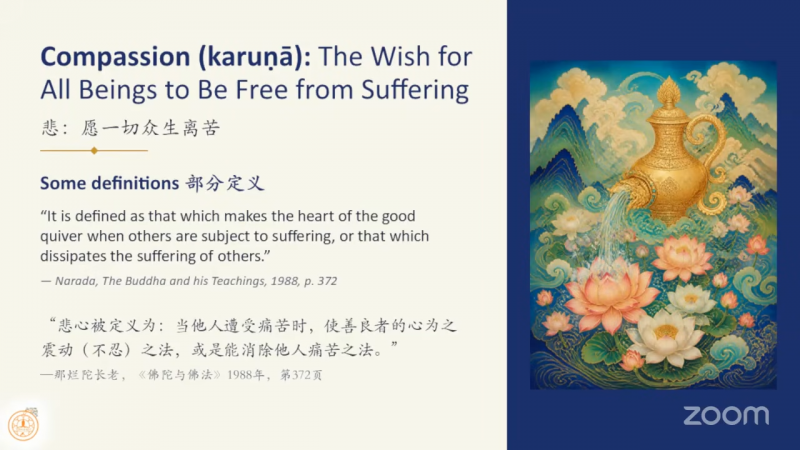
2. COMPASSION (karuṇā):
- the wish for all beings to be free from suffering.
“It is defined as that which makes the heart of the good quiver when others are subject to suffering, or that which dissipates the suffering of others.”(Narada, The Buddha and his Teachings, 1988, p.372)
“Compassion does not mean to suffer with the other. That is a very important point. Instead of being a painful mental condition in which we suffer with the other, compassion is a positive mental state that is open to the suffering but envisions an improvement of the condition of the other and is willing to go out of one’s way to help and aid the other person to reach that condition. It is out of that willingness to give priority to helping the other – that is where the joy comes from. This is a way of thinking and a way of acting that improves the mind, and so it is also good for oneself. (Bhikkhu Anālayo, “An Interview with Bhikkhu Anālayo on his new book, Compassion and Emptiness in Early Buddhist Meditation”, Insight Journal, 2015. (https://www.Buddhistinquiry.org/article/cultivating-the-brahmaviharas/)
Importance of Compassion (karuṇā):
1. It is a prerequisite for a harmonious society.
Compassion for the life, feelings, and security of others is inseparably linked to the first four precepts.
Do NOT kill living beings.
Do NOT steal.
Do NOT engage in sexual misconduct.
Do NOT lie or use harmful speech.
2. It is an essential attitude for progress along the path towards Nibbāna.
The development of compassion plays an essential part in the meditation practice that leads towards wisdom and the destruction of craving. The development of a compassionate mind is a direct preparation for right concentration and a prerequisite of Nibbāna.
3. After enlightenment, it is compassion that led the Buddha to teach to liberate people from suffering.
Mahāyāna development of the Concept of Compassion:
In Mahāyāna Buddhism, the concept of compassion has been developed further and is given much emphasis with the Bodhisattva Ideal.
Bodhisattvas aspire to become enlightened in order to liberate sentient beings. This bodhisattva inspiration is out of compassion for all suffering beings.
Compassion is the driving force.
Examples of the Great Compassion of Buddhas and Bodhisattvas:
Amitabha Buddha
Amitabha Buddha’s 18th Vow:
" If, when I attain Buddhahood, sentient beings in the lands of the ten directions who sincerely and joyfully entrust themselves to me, desire to be born in my land, and call my Name, even ten times, should not be born there, may I not attain perfect Enlightenment. Excluded, however, are those who commit the five gravest offences and abuse the right Dharma."
Kṣitigarbha Bodhisattva:
Kṣitigarbha Bodhisattva vowed to delay achieving Buddhahood until all hells are emptied, embodying infinite compassion.
Avalokitesvara Bodhisattva:
Avalokitesvara Bodhisattva is associated with great compassion. As stated in the Pu Men Pin, Avalokitesvara Bodhisattva will heed those who call upon him and save them from numerous sufferings – fire, storms on the ocean, murderers, demons and ghosts, robbers, etc.
For more information, please browse https://www.youtube.com/live/JNRXEVfS49E
Spread the Buddha's teachings to guide more people to study Buddhism.
Continue diligently in the path studying the Buddha's teachings and listening to the Dharma.
Follow us on:
https://linktr.ee/thanhsiang