Submitted by aier on
Than Hsiang's Pu Men Pin Online Gong Xiu Dharma Sharing (09/01/2026)
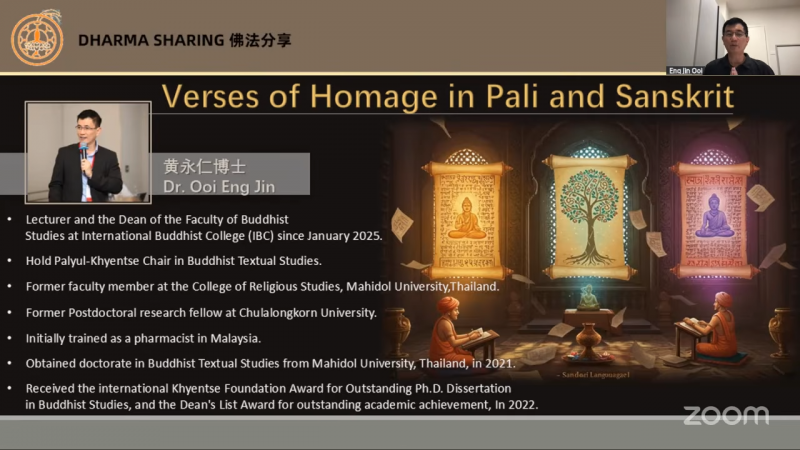
Lecturer and the Dean of the Faculty of Buddhist Studies at IBC, Dr. Ooi Eng Jin sharing "Verses of Homage in Pali and Sanskrit "
Today, I would like to share with you some Verses of Homage in Pāli and Sanskrit.
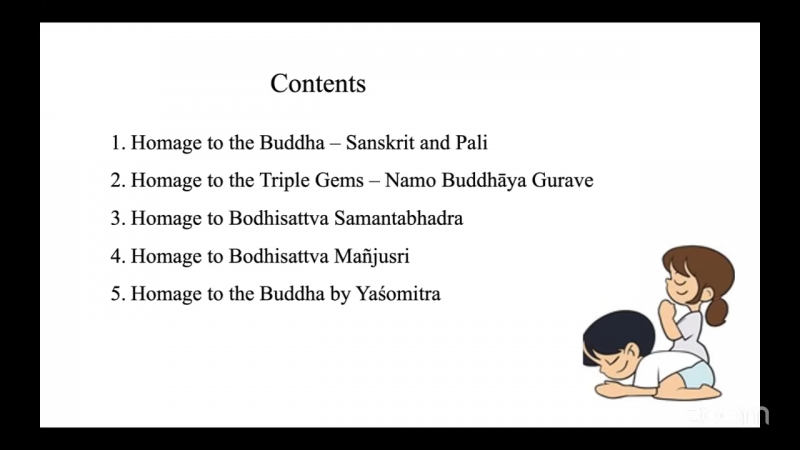
I will share 5 chosen verses with you:-
1. Homage to the Buddha - Sanskrit and Pāli
2. Homage to the Triple Gems - Namo Buddhāya Gurave
3. Homage to Bodhisattva Samantabhadra
4. Homage to Bodhisattva Mañjusri
5. Homage to the Buddha by Yaśomitra
The first verse is “Homage to the Buddha,” a very common homage you can hear in Malaysia quite often, especially the Pāli version, the “Namo Tassa” version.
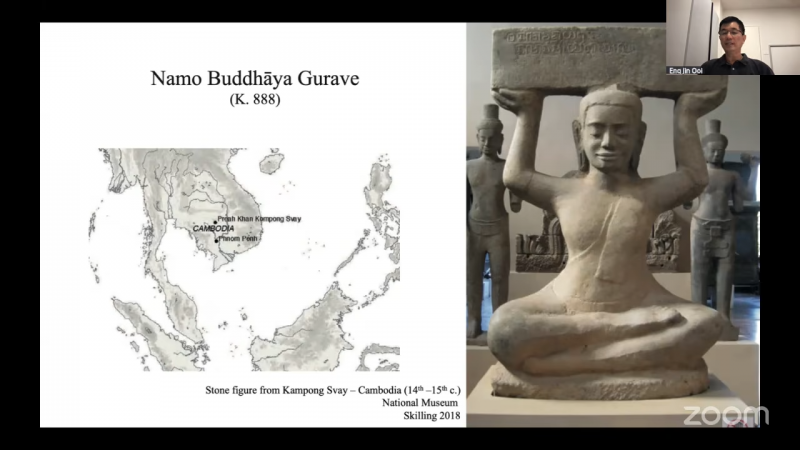
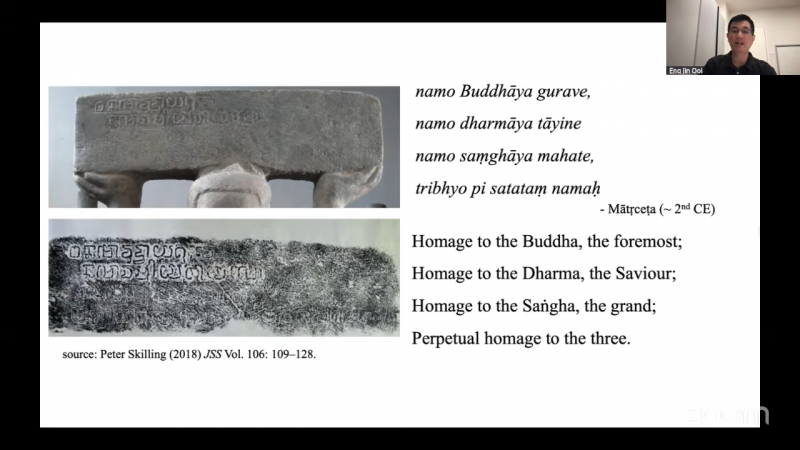
And the second verse is “Homage to the Triple Gems,” some calling it “Namo Buddhāya Gurave.” This is the verse that was found in an inscription on the sculpture in Cambodia, a Sanskrit verse.
The third verse is “Homage to Bodhisattva Samantabhadra.”
The fourth verse is “Homage to Bodhisattva Mañjusri.”
And the last verse is “Homage to the Buddha,” composed by Yaśomitra ( a very renowned Sanskrit scholar who gave commentary to the Abhidharmakośabhāṣya ) .
Ok, let me start with the first verse.
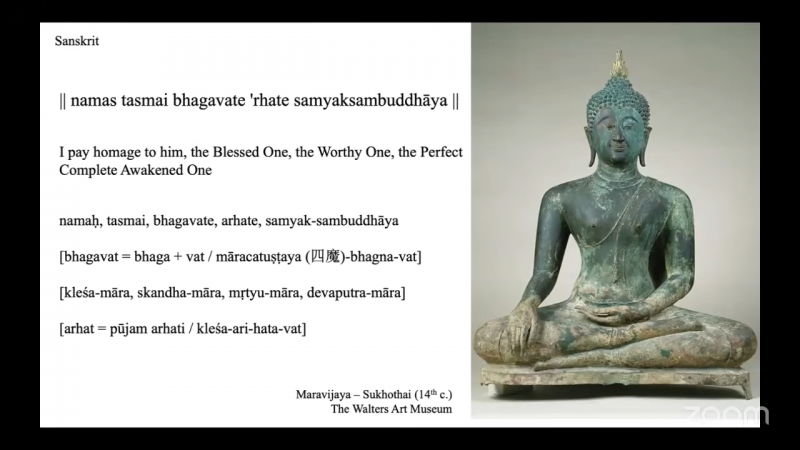
The first verse is in Sanskrit. And you can see I've typed out the Sanskrit verse here. And I'm going to chant this verse three times. And if you want, you can also join me in chanting this. Afterwards, I will explain its meaning.
|| namas tasmai bhagavate 'rhate samyaksambuddhāya ||
Now, look at this verse in Sanskrit, you can see the first word is “nama” or “namas” in the verse.
“nama” here means: Paying homage ( or some people translate it as “ to bow”, or “ to venerate”, or “ to revere ”. )
The second word is “tasmai”.
“tasmai” comes from the word called “tat”, that means “he, she or that”.
And “Tasmai” here means “to him”, here means “paying homage to him- the Buddha ”
Then the third word is “bhagavate”.
“bhagavate” has two explanations.
The first explanation is [bhagavat = bhaga + vat ]
“vat” is a suffix in Sanskrit, means “one who possesses”,
So, one who possesses what?
One who possesses “bhaga”.
What is “bhaga”?
“bhaga” means blessing.
Therefore, one who possesses “bhaga” (blessing) is called a “bhagavat”.
So, that's why we translate the “bhagavat” as “The Blessed one”.
So, “bhagavate” means “to the blessed one”.
Another meaning of “bhagavat” is “māracatuṣṭaya-bhagna-vat”, meaning one who possesses “bhagna” to distraction of māracatuṣṭaya, basically the four māras ( 四魔 ).
And, what are these four māras?
• Kleśa-māra,
• Skandha-māra,
• Mṛtyu-māra,
• Devaputra-māra
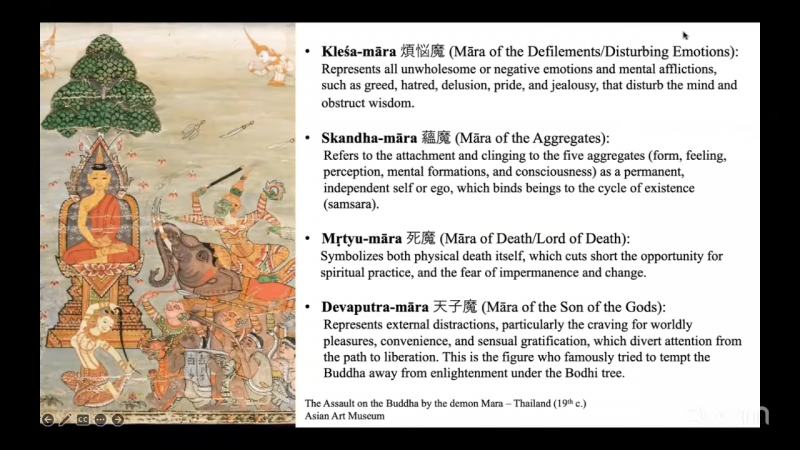
The first māra is the Kleśa-māra (烦恼魔), the Māra of the Defilements And Disturbing Emotions. This māra represents all unwholesome or negative emotions and mental afflictions, such as greed, hatred, delusion, pride, and jealousy, that disturb the mind and obstruct wisdom.
The second māra we are talking about is Skandha-māra(蕴魔), the Māra of the Aggregates. This māra refers to the attachment and clinging to the five aggregates (form, feeling, perception, mental formations, and consciousness) as a permanent, independent self or ego, which binds beings to the cycle of existence (samsara).
The third māra is the Mṛtyu-māra(死魔), the Māra of Death/Lord of Death. This māra symbolizes both physical death itself, which cuts short the opportunity for spiritual practice, and the fear of impermanence and change.
The fourth māra is the Devaputra-māra(天子魔), the Māra of the Son of the Gods. This māra represents external distractions, particularly the craving for worldly pleasures, convenience, and sensual gratification, which divert attention from the path to liberation. This is the figure who famously tried to tempt the Buddha away from enlightenment under the Bodhi tree.
So, these are the four māras.
The fourth word is “arhate”.
“arhate” also has two meanings.
The first meaning is “ pūjam arhati ” — worthy of puja
The second meaning is “kleśa-ari-hata-vat”.
“vat” means possess, one who possess the destruction of the enemy of “Kleśa”.(“Kleśa” here is “defilement”).
So, basically therefore we call “arhate” or “ the Worthy one.( 罗汉 in Chinese)
And then the last word is “samyak-sambuddhāya”.
“samyak” here means “perfectly complete”.
“sam” means altogether complete, Buddha ( Buddha means awakened).
So, “samyak-sambuddhāya” means “perfectly or completely awakened one”.
So the whole verse will then be translated as “I pay homage to the Blessed One, the Worthy One, the Perfectly Complete Awakened One”.
Ok, let's move on to the next verse.
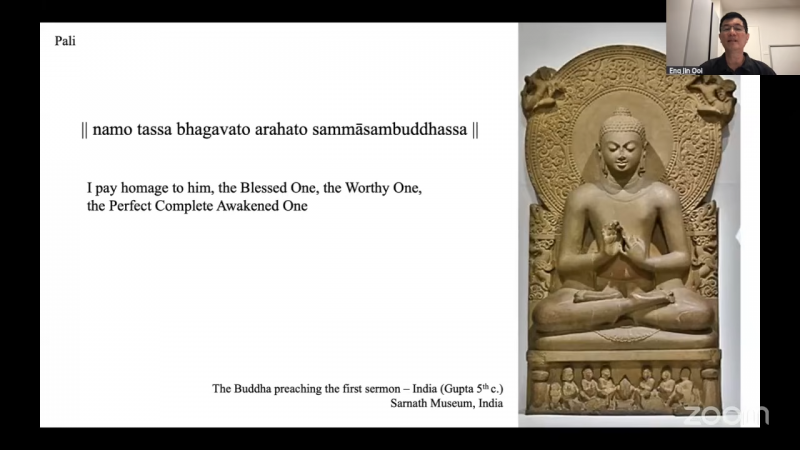
The next verse is the same like the first verse, but it is in the Pāli verse. (This is quite common; before we start chanting, we chant this verse first. )
|| namo tassa bhagavato arahato sammāsambuddhassa ||
So, the meaning of this verse is exactly the same like the previous verse, but it is in Pāli, The earlier one is in Sanskrit.
So again, it means “ I pay homage to him- The blessed one, the Worthy One, the Perfectly Complete Awakened One”.
Ok, The second verse I want to share with you is called the “Namo Buddhāya Gurave”, so you can see here a statue holding up a block. This statue dated to the 14th to 15th century. It was discovered or recovered from Kampong Svay in Cambodia. So, you can see here on this map that it is above Phnom Penh.
On top of this block that this figure is holding, look at him: he's smiling, with his eyes semi-closed, very serene, and there are inscriptions on top of it. If you look at this, here are the inscriptions. So, you can see the inscription here is:
“namo Buddhāya gurave,
namo dharmāya tāyine,
namo saṃghāya mahate,
tribhyo pi satataṃ namaḥ”
So, there is a verse of these four parts.
This verse is, actually, what they found initially, they thought it was a pāli verse, but then they later, it was not a pāli verse, it is a Sanskrit verse. )
This verse is composed by Mātṛceṭa (~ 2nd CE).
Mātṛceṭa is a very popular and famous Indian poet who was initially Hindu and then became a Buddhist around the second century.
So, the first word “namo” , as we discussed earlier, means “homage”.
“Buddhāya” means “to the Buddha”. So, we always say “namo Buddhāya”, means “Homage to the Buddha”.
So “gurave” means the foremost…
The second “pada” is “namo dharmāya”, means “Homage to the Dharma”.
“Tāyine” means the Saviour;
The third “pada” is “namo saṃghāya ”, means “Homage to the Saṅgha”,
And, “mahate” means the grand, The grand Saṅgha.
And then the fourth “pada” is “tribhyo pi satataṃ namaḥ”, means “ perpetual homage to the three ( “tribhyo” ).
So, this is a beautiful verse to pay homage to the triple gem.
Translation:
“I pay homage to the Blessed One, the Worthy One, the Perfect Complete Awakened One”
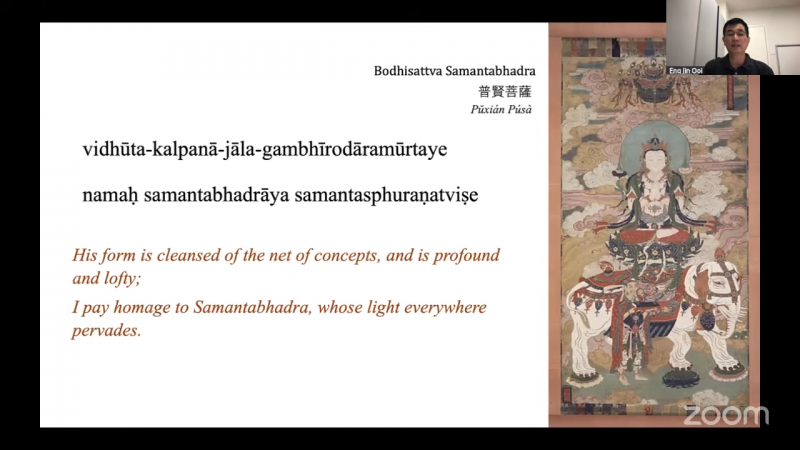
The third verse is a verses of homage to Bodhisattva Samantabhadra普賢菩薩 (Pǔxián Púsà).
vidhūta-kalpanā-jāla-gambhīrodāramūrtaye
namaḥ samantabhadrāya samantasphuraṇatviṣe
Translation:
His form is cleansed of the net of concepts, and is profound and lofty;
I pay homage to Samantabhadra, whose light everywhere pervades.
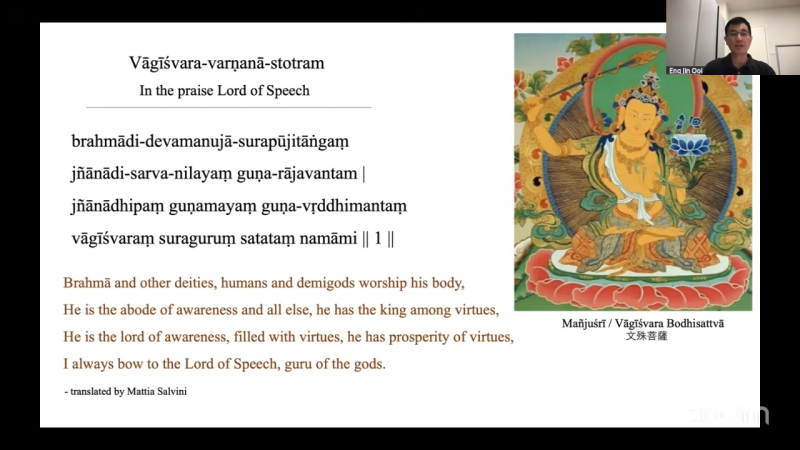
The fourth verse is pay homage to Mañjuśrī / Vāgīśvara Bodhisattvā (文殊菩薩) or The Lord of speech.
brahmādi-devamanujā-surapūjitāṅgaṃ
jñānādi-sarva-nilayaṃ guṇa-rājavantam |
jñānādhipaṃ guṇamayaṃ guṇa-vṛddhimantaṃ
vāgīśvaraṃ suraguruṃ satataṃ namāmi || 1 ||
Translation:
Brahmā and other deities, humans and demigods worship his body,
He is the abode of awareness and all else, he has the king among virtues,
He is the lord of awareness, filled with virtues, he has prosperity of virtues,
I always bow to the Lord of Speech, guru of the gods.
brahmādi-deva = Brahmā and other deities (ādi means “and other”).
Manujā= humans
surapūjitāṅgaṃ= worship his body ( tāṅgaṃ means his body).
jñānādi-sarva-nilayaṃ= He is the abode of awareness and all else
guṇa-rājavantam = he is the king among the virtues
jñānādhipaṃ guṇamayaṃ= He is the lord of awareness. ( ādhipa=lord, jñāna= awareness)
guṇamayaṃ= “maya” in Sanskrit is a suffix basically means “filled with”, “guṇa” means “virtues”, it all means “ filled with virtues”.
guṇa-vṛddhimantaṃ= mantam is a suffix indicating possession, essentially “One who possesses”, One who possesses “vṛddhi” ( “vṛddhi” means prosperity).
vāgīśvaraṃ suraguruṃ satataṃ namāmi= “namāmi ”means “I bow or I homage”. “satataṃ” means always-I always bow to the Lord of Speech, the guru of the gods.
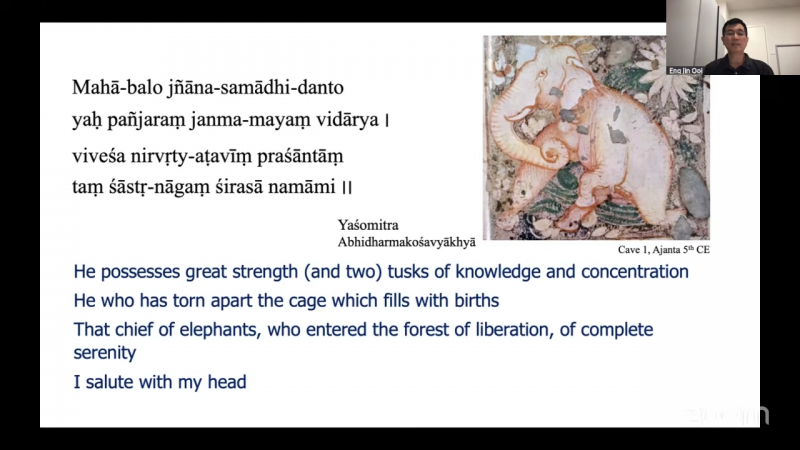
So the last verse for today is composed by Yaśomitra, the one who composed the Abhidharmakośavyākhyā)( commentary to Vasubandhu’s Abhidharma-kośa). So. he composed this before he started his commentary works.
Mahā-balo jñāna-samādhi-danto
yaḥ pañjaraṃ janma-mayaṃ vidārya ׀
viveśa nirvṛty-aṭavīṃ praśāntāṃ
taṃ śāstṛ-nāgaṃ śirasā namāmi ׀׀
Translation:
He possesses great strength (and two) tusks of knowledge and concentration
He who has torn apart the cage which fills with births
That chief of elephants, who entered the forest of liberation, of complete serenity
I salute with my head.
For more information, please browse https://youtu.be/EmJUyUJz1Kg
Spread the Buddha's teachings to guide more people to study Buddhism.
Continue diligently in the path studying the Buddha's teachings and listening to the Dharma.
Follow us on:
https://linktr.ee/thanhsiang